Budget
How Much Does It Cost to Build a Prop? A Maker's Budget Guide
Prop building costs $40-800+ depending on materials and complexity. Here's the full cost breakdown for EVA foam, 3D printed, resin cast, and mixed media props, plus the hidden expenses that add up fast.
A finished prop costs $40-800+ depending on how you build it
I've been building props for cosplay and display for nine years. Swords, blasters, shields, staffs, helmets, gauntlets, a full-scale Portal gun that took three months and an amount of money I've only recently come to terms with. My workshop has produced somewhere around 120 finished props, and I've tracked costs on every single one since build number eight, when a "quick little dagger" turned into a $160 lesson in scope creep.
The cost of a prop depends on three things: material choice, level of detail, and whether electronics are involved. A simple EVA foam sword runs $40-60. A screen-accurate blaster with electronics, resin cast details, and weathering can push past $800. Most props land in the $80-250 range, which is where the interesting budget decisions happen.
Before you buy anything, plug your build into the Craft Build Cost Estimator to get a realistic number. Then come back here to understand where every dollar goes.
EVA foam props: $40-150
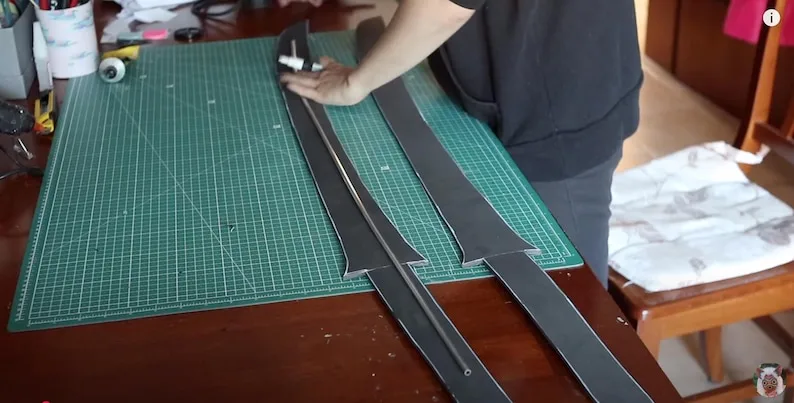
Foam is the entry point for prop making, just like it is for armor. It's light, cheap, easy to shape, and forgiving of mistakes.
Materials for a standard foam prop (sword, axe, or staff):
| Material | Cost |
|---|---|
| EVA foam sheets (6-10mm, 2-3 sheets) | $14-27 |
| PVC pipe or dowel (internal support) | $3-8 |
| Contact cement (Barge, small can) | $8-12 |
| Foam clay (detail work) | $12-16 |
| Plasti Dip or Flexbond (sealer) | $8-14 |
| Acrylic paint (3-4 colors) | $12-24 |
| Clear coat spray | $8-12 |
| Total | $65-113 |
Simpler props like daggers and small shields can come in under $50 by skipping foam clay and using fewer paint colors. Complex foam props like large two-handed weapons or shields with dimensional details push toward $120-150 because you're using more foam, more adhesive, and more finishing materials.
The real cost advantage of foam is mistake tolerance. Mess up a cut? Grab another piece for $1.50. Try that with a 3D print that took 14 hours and $8 in filament and the math hits different.
I built my first foam sword, a basic fantasy broadsword, for $52. It looked decent from five feet away and terrible up close. My 40th foam sword cost $75 and looks good from any distance. The cost difference is $23. The skill difference is two years of practice. Foam lets you practice cheaply.
3D printed props: $30-250 (plus printer)
If you already own a 3D printer, printed props are shockingly cheap in raw materials. If you don't own a printer, the startup cost changes the calculus entirely.
Materials for a 3D printed prop:
| Material | Cost |
|---|---|
| PLA/PETG filament (per prop, 200-800g) | $5-20 |
| Filler primer (multiple cans) | $12-24 |
| Sandpaper (assorted grits, lots of it) | $8-15 |
| Bondo/spot putty (seam filling) | $8-12 |
| Acrylic paint + clear coat | $20-40 |
| Epoxy or CA glue (joining parts) | $6-12 |
| Total (filament + finishing) | $59-123 |
| FDM printer (if you don't own one) | $200-400 |
The filament itself is the cheapest part. A kilogram spool runs $18-25 and most props use 200-800 grams. A blaster pistol might use $6 in filament. A full-length rifle uses $15-20.
The real cost is post-processing. Every 3D printed prop needs layer lines sanded away, seams filled where multi-part prints join, and multiple coats of filler primer before paint. That post-processing eats through sandpaper, primer, and putty at a rate that surprises every new printer owner.
I remember my first printed prop, a Mandalorian blaster pistol. The filament cost $7. I was thrilled. Then I spent $35 on filler primer, sandpaper, and Bondo getting rid of the layer lines. Then $18 on paint. The $7 prop cost $60 finished, which is still a great price, but it wasn't the $7 I bragged about on the cosplay subreddit.
Print farm services like Craftcloud or local makerspaces charge $30-100+ for the print alone if you don't own a printer. At that point, the cost advantage over foam disappears unless you specifically need the geometric precision that printing provides.
Resin casting: $80-300+
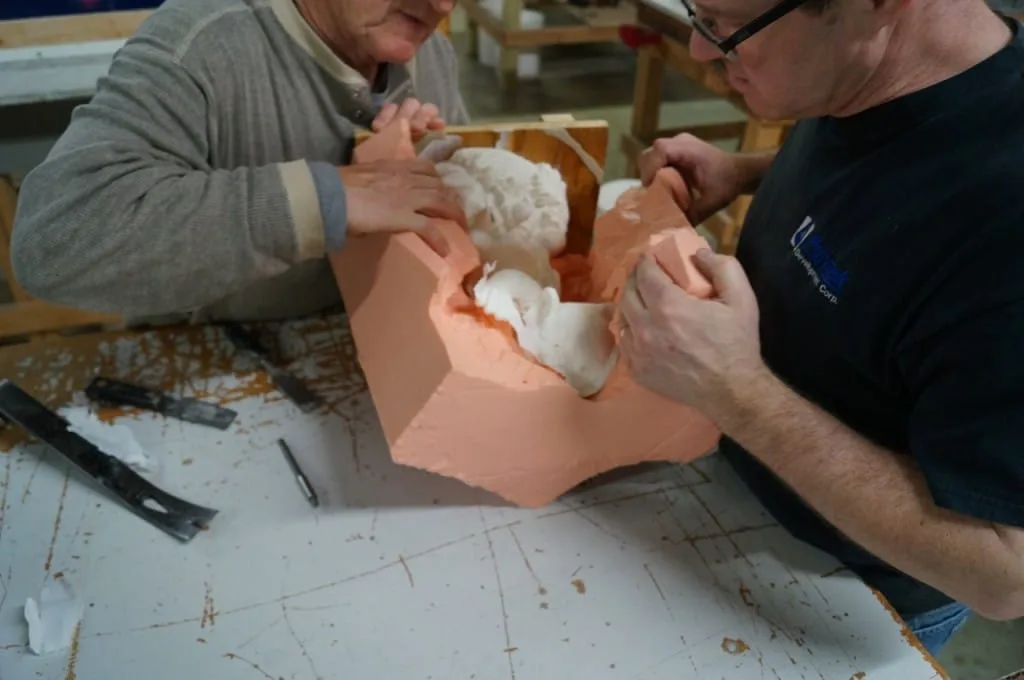
Resin casting is for prop makers who want to produce multiple copies, build transparent or translucent parts, or achieve a specific weight and hardness that foam and filament can't match.
Materials for a resin cast prop:
| Material | Cost |
|---|---|
| Silicone rubber (mold making, 1-2 lbs) | $25-50 |
| Casting resin (polyurethane, 1-2 lbs) | $20-40 |
| Mold release agent | $8-12 |
| Master (3D printed or sculpted original) | $10-40 |
| Mixing cups, stir sticks, disposable brushes | $5-10 |
| Pigments or dyes | $8-15 |
| Sandpaper and finishing supplies | $10-20 |
| Paint + clear coat | $15-30 |
| Total | $101-217 |
The upfront cost is higher than foam or printing, but resin casting amortizes beautifully if you're making multiples. A silicone mold costs $25-50 to make and produces 20-50 castings. If you're making a set of matching gemstones for a costume, or duplicating a decorative detail across multiple props, the per-unit cost drops to a few dollars after the mold is made.
Resin also gives you material properties nothing else can match. Transparent crystal effects for magic staffs, heavy weighted pommels for swords, glossy gem-like surfaces without paint. I cast a set of translucent blue crystals for a staff build that would have been impossible in any other material. The mold cost $30 to make, each crystal costs $2 in resin, and I've pulled 35 castings from the same mold.
The hidden cost of resin: ventilation. Polyurethane resin produces fumes that require real ventilation, not "crack a window" ventilation. If you don't already have a workshop with ventilation, adding a respirator ($25-35) and working outdoors or in a garage is the minimum safe setup.
Mixed media props: $100-350
Most of my best props use multiple materials. A foam core with 3D printed detail pieces. A PVC pipe frame with foam cladding and resin cast gems. Mixed media gives you the strengths of each material where they matter most.
Typical mixed media prop (detailed sword or staff):
| Component | Material | Cost |
|---|---|---|
| Core structure | PVC pipe + wooden dowel | $5-12 |
| Body/blade | EVA foam (2-3 sheets) | $14-27 |
| Detail pieces | 3D printed or foam clay | $10-30 |
| Gems/crystals | Resin cast or acrylic cabochons | $5-20 |
| Wrap/grip | Leather strip or paracord | $5-12 |
| Adhesive | Contact cement + epoxy | $12-20 |
| Finishing | Primer + paint + clear coat | $25-45 |
| Total | $76-166 |
Mixed media is where experienced prop makers naturally end up because you stop thinking in terms of "foam prop" or "printed prop" and start thinking in terms of "what material does this specific part need." The blade of a sword needs to be light and impact-resistant? Foam. The crossguard needs crisp geometric edges? 3D printed. The pommel gem needs to glow translucent? Resin cast. The grip needs texture? Leather wrap.
My current favorite build approach is a foam body with 3D printed hard-surface details epoxied on. The foam keeps the prop light and convention-safe, and the printed details provide the crispness that foam can't achieve in small geometric shapes. A sword built this way costs $80-140 and photographs like a $300 build.
Electronics and LEDs: add $20-150
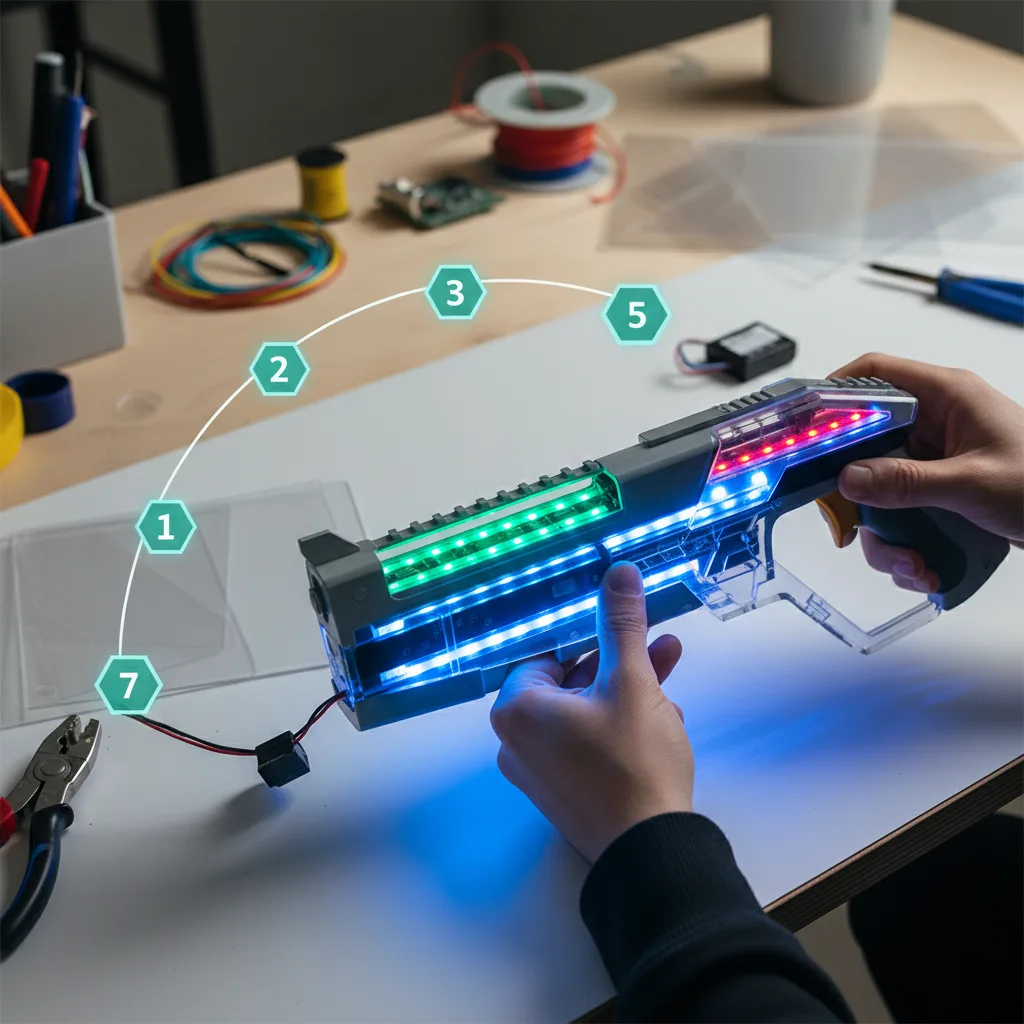
Lighting transforms a prop from impressive to show-stopping, and it's more accessible than most people think.
| Component | Cost |
|---|---|
| LED strip (addressable, 1m) | $8-15 |
| Arduino Nano or similar microcontroller | $5-12 |
| Battery pack (rechargeable) | $10-25 |
| Wiring, connectors, solder | $5-10 |
| Diffusion material (wax paper, translucent plastic) | $3-8 |
| Switch | $2-5 |
| Basic LED setup total | $33-75 |
| Sound module (DFPlayer + speaker) | $8-15 |
| Smoke/fog module | $15-30 |
| Advanced effects (NeoPixel blade, etc.) | $40-100+ |
A simple static LED glow, the kind that makes a crystal staff or blaster barrel light up, costs $20-40 in components and takes an afternoon to wire. No coding required if you're using a basic circuit with a switch.
Animated effects (pulsing, color-changing, reactive) require an Arduino or similar controller and basic code, but the components are cheap. The entire NeoPixel ecosystem runs on $5-12 microcontrollers and $8-15 LED strips.
Where electronics get expensive is when you're adding multiple systems. A lightsaber-style prop with a full NeoPixel blade, motion-reactive sound, and smooth ignition effects can run $80-150 in electronics alone before you touch the hilt construction.
I add LEDs to about half my builds now. The sweet spot is a $30-40 electronics package: addressable LED strip, Arduino Nano, rechargeable battery, and a hidden switch. It takes 2-3 hours to integrate and adds more visual impact per dollar than any other upgrade.
Cost by complexity tier
| Tier | Example | Materials | Electronics | Total |
|---|---|---|---|---|
| Simple foam prop | Dagger, small shield, wand | $40-80 | None | $40-80 |
| Detailed mixed media | Fantasy sword, sci-fi pistol, staff | $80-200 | Optional ($20-40) | $100-240 |
| Screen-accurate replica | Named weapon, hero blaster, iconic prop | $150-400 | Often ($40-150) | $200-550 |
| Exhibition piece | Full-scale display replica with electronics | $250-500+ | Yes ($80-200) | $330-700+ |
Most convention-going cosplayers operate in the first two tiers. Competition entrants and serious collectors push into tier three. Tier four is for display builders and commission work.
The hidden costs that blow every prop budget
Sandpaper: $15-40/year. This is the one that got me. Sandpaper is a consumable and you burn through it fast, especially on 3D printed props. A single prop can eat through $5-8 in sandpaper across grits from 80 to 600. I buy variety packs of 50-100 sheets and go through two to three packs a year.
Filler primer: $20-50/year. Rust-Oleum Filler Primer is the prop maker's best friend and worst budget enemy. At $6-8 per can, and 2-4 cans per detailed prop, it adds up to the single largest consumable cost in finishing. I've gone through 30+ cans in a year during heavy build seasons.
Replacement blades: $10-20/year. Exacto blades, box cutter blades, rotary cutter blades. EVA foam dulls blades fast. A dull blade tears foam instead of cutting it, ruining pieces you then have to recut. Fresh blades matter. I swap Exacto blades every 20-30 minutes of foam cutting.
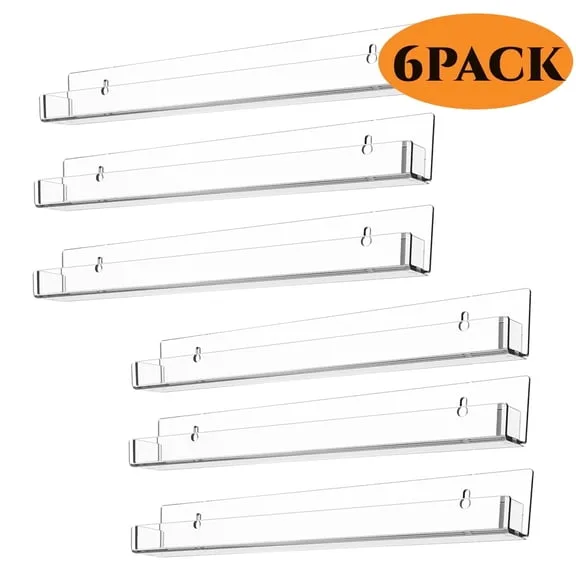
Display stands: $15-60 per prop. Nobody budgets for display, and then your finished prop sits on a shelf leaning against a wall looking sad. A simple acrylic stand runs $10-20. A custom wood mount or wall display runs $25-60. For a prop you spent $200 building, a $20 stand is a no-brainer investment in presentation.
Test pieces and failed attempts: $20-50/year. Every new technique requires test cuts, test prints, test casts. These aren't wasted materials, they're tuition. But they cost real money. I keep a scrap bin specifically for practice cuts and test paint schemes, and I budget for it explicitly now instead of pretending every piece of material goes into the final prop.
Hidden costs total $80-220 per year for an active prop maker building 6-12 props annually. That's $7-18 per prop in overhead that never appears in the materials list.
Where to save without sacrificing quality
Buy primer in bulk. Filler primer is the biggest consumable cost. Buying a case of 6 cans saves 15-20% over individual cans. If your local hardware store doesn't stock cases, online retailers do.
Use the right material for each part. Don't 3D print something you can cut from foam in ten minutes. Don't sculpt foam clay details you could print in an hour. Material matching, using the cheapest material that achieves the result you need for each component, is the single biggest budget lever.
Salvage and reuse. PVC pipe from a scrapped prop becomes the core of the next one. Foam offcuts become detail pieces or test material. LED strips can be desoldered and reused. I estimate 15-20% of my materials budget comes from salvaged components across builds.
Design for your skill level. The most expensive prop is the one you abandon halfway through because the technique was beyond your current ability. If you've never done resin casting, don't make your first cast a critical component of a competition build. Practice the technique on a $20 test project first.
Model before you build. Spending an hour sketching your prop with dimensions and a materials list saves more money than any coupon code. I've caught three-digit mistakes on paper that would have been three-digit losses in materials. The Craft Build Cost Estimator helps here by forcing you to list every material before you buy anything.
Material comparison
| Material | Cost range (finished) | Weight | Detail level | Beginner friendly? |
|---|---|---|---|---|
| EVA foam | $40-150 | Light | Medium | ✓ Yes |
| 3D printed (FDM) | $30-250 (+printer) | Medium-heavy | High | Moderate |
| Resin cast | $80-300+ | Heavy | Very high | — |
| Mixed media | $100-350 | Varies | High | Moderate |
| Wood | $30-100 | Heavy | Medium | Moderate |
Foam is the best starting material for most prop makers. 3D printing excels when you need geometric precision or complex shapes that are hard to cut by hand. Resin casting shines for multiples and transparent effects. Mixed media is where most experienced makers land for convention props.
First prop shopping list
If you're building your first prop, here's a minimalist shopping list for a foam sword or dagger.
| Item | Cost |
|---|---|
| EVA foam (10mm, 2 sheets) | $14-18 |
| Wooden dowel (core) | $3-5 |
| Contact cement (small) | $8-12 |
| Plasti-Dip (1 can) | $8-12 |
| Acrylic paint (2 colors + metallic) | $10-18 |
| Clear coat (1 can) | $8-12 |
| Exacto knife + blades | $8-12 |
| Total | $59-89 |
That's everything you need for a solid first build. Add a heat gun ($25-35) if you want to shape curves and seal edges, but it's optional for a flat-profile weapon like a sword or dagger. My recommendation: build the first one without a heat gun. If you enjoy the process, buy the heat gun for build two.
Frequently
asked questions.
Sources & references
We link to the brands, retailers, and research we reference so you can verify and explore.