Budget
How Much Does Ren Faire Garb Cost to Make?
DIY ren faire garb costs $60-150 for a peasant kit, $150-400 for a merchant outfit, and $400-1000+ for full historical recreation. Real fabric, leather, and notions breakdown inside.
The real cost of ren faire garb, from tavern wench to Tudor noble
I started sewing ren faire garb twelve years ago with a muslin chemise I cut on my bedroom floor using a pattern I traced from a library book. That chemise cost me $14 in fabric and it's still in my kit bag. Last year I finished a Tudor court gown with hand-bound eyelets, silk brocade panels, and a structured corset foundation. That project ran $870 in materials alone.
Both outfits work at faire. But nobody told me at the start how the costs layer up once you move beyond basic garb, and I blew my budget on three separate builds before I figured out where the money actually goes.
Here's the honest breakdown so you can plan properly. If you want a quick estimate first, plug your garb list into the Craft Build Cost Estimator and come back for the details.
Fabric costs: the biggest line item
Fabric is 40-60% of your total garb budget. The type you choose determines both cost and authenticity, and the range is enormous.
| Fabric | Price per yard | Yards for a basic outfit | Subtotal |
|---|---|---|---|
| Muslin (chemise/shift) | $3-5 | 3-4 yards | $9-20 |
| Medium-weight linen | $10-18 | 4-6 yards | $40-108 |
| Cotton broadcloth (budget alternative) | $4-8 | 4-6 yards | $16-48 |
| Wool suiting/gabardine | $12-25 | 3-5 yards | $36-125 |
| Silk dupioni | $15-30 | 2-4 yards | $30-120 |
| Brocade/jacquard | $18-40 | 2-4 yards | $36-160 |
| Velvet (cotton or silk) | $15-35 | 2-3 yards | $30-105 |
Linen is the gold standard for ren faire garb. It breathes in summer heat, looks period-appropriate, and develops beautiful drape with washing. It also costs three to four times what cotton broadcloth costs. For a first outfit, cotton is a completely acceptable substitute that nobody at faire will call out.
The yardage numbers above assume an average adult. Larger sizes or fuller skirts need 20-40% more fabric. I learned this the hard way on my second kirtle when I cut the skirt panels too narrow for proper gores and had to buy another two yards of wool at $18/yard to fix it.
Where you buy matters as much as what you buy. Quilting cotton from a chain craft store runs $12-15/yard. The same weight from an online fabric warehouse costs $5-8. Linen from a dedicated supplier like Fabrics-Store.com runs $10-18/yard, but the same weight at a brick-and-mortar shop can hit $25+.
Cost tiers: from peasant kit to full historical recreation
Tier 1: Simple peasant kit ($60-150)
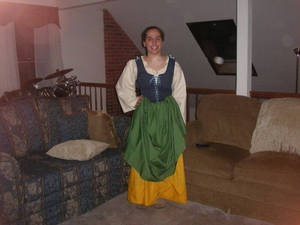
This is the entry point for your first faire. A chemise or shift, an outer garment, and basic accessories. It reads as "ren faire" from across the lane and it's comfortable all day.
| Item | Materials cost |
|---|---|
| Chemise/shift (muslin or cotton) | $12-25 |
| Skirt or trousers (cotton or linen blend) | $15-35 |
| Bodice or vest (cotton, front-lacing) | $12-30 |
| Simple belt (leather or fabric sash) | $5-15 |
| Head covering or hat | $3-10 |
| Thread, closures, basic notions | $5-12 |
| Pattern (commercial or self-drafted) | $8-16 |
| Total | $60-143 |
Most people land at $80-120 for a first kit when they use cotton broadcloth and a commercial pattern from Simplicity or McCall's. The costume pattern lines from both companies have solid ren faire options in the $12-16 range and they go on sale for $2-5 regularly.
A peasant kit is not historically accurate, and that's fine. Nobody at a Renaissance Pleasure Faire is checking your seam finishes for period correctness. What matters is that you're comfortable, covered, and having fun. I wore my first peasant kit to seven faires over two years before I upgraded, and I still pull pieces from it for layering.
Tier 2: Merchant or noble outfit ($150-400)
This is where garb starts looking intentional. Better fabrics, structured garments, leather accessories, and period-appropriate closures.
| Item | Materials cost |
|---|---|
| Linen chemise/shift | $25-45 |
| Kirtle, cotehardie, or doublet (linen or wool) | $40-90 |
| Overskirt, surcoat, or jerkin | $25-60 |
| Leather belt with buckle | $15-35 |
| Leather pouch or belt bag | $10-25 |
| Lacing (cotton or linen cord) | $3-6 |
| Grommets/eyelets and setter | $8-15 |
| Better closures (hooks, hand-sewn eyelets) | $5-12 |
| Trim or braid (per yard) | $3-8/yard, 3-5 yards |
| Pattern (specialized historical) | $12-22 |
| Total | $156-338 |
The jump from Tier 1 to Tier 2 is driven by two things: fabric quality and structure. Moving from cotton broadcloth to real linen adds $30-60 to the chemise and outer garment. Adding a structured bodice or doublet with proper boning channels, grommets, and lacing turns a costume into a garment.
Leather starts appearing at this tier. A real leather belt runs $15-35 in materials if you cut and finish it yourself. A belt pouch adds $10-25 in leather and hardware. These are the accessories that make an outfit look lived-in rather than costumed.
This is the tier where most regular faire-goers settle. You look put-together, you can add layers and accessories over time, and the garments are durable enough to last years of weekend faires.
Tier 3: Full historical recreation ($400-1000+)
This is where the research drives the spending. You're building garments based on specific historical periods, using documented construction methods and period-appropriate materials.
| Item | Materials cost |
|---|---|
| Linen chemise (hand-finished) | $30-55 |
| Structured corset/stays or pourpoint | $60-120 |
| Main garment (wool, silk, or brocade) | $80-200 |
| Overgown, surcoat, or cloak (lined) | $60-150 |
| Leather accessories (belt, shoes, gloves) | $40-100 |
| Period closures (hand-sewn eyelets, hooks, lacing rings) | $15-30 |
| Trim, braid, and embellishment | $20-60 |
| Headwear (structured hood, cap, or coif with veil) | $15-40 |
| Undergarments/support layers | $20-45 |
| Specialty notions (boning, interfacing, lining fabric) | $20-40 |
| Reference patterns (historical reconstructions) | $15-30 |
| Total | $375-870 |
The realistic range hits $400-1000+ because material choices at this level are expensive. Silk brocade at $25-40/yard for a Tudor forepart eats $75-160 on one panel. Wool for a full gown with train uses 6-8 yards at $15-25/yard. A structured corset needs steel boning ($15-25 for a set), coutil or twill for the foundation ($20-30), and a fashion fabric outer layer.
I spent six months on my Tudor court gown. The silk brocade bodice panels alone cost $120. The wool outer gown was $180 in fabric. Hand-sewing the 42 eyelets took an entire weekend. Was it worth it? At the SCA event where three people asked me to explain my construction methods, absolutely. At a casual weekend faire, that level of investment isn't necessary.
Hidden costs that wreck garb budgets
Every costumer I know has been blindsided by the same expenses. Small purchases that seem trivial but add up across a build.
Thread: $8-20. Good polyester or cotton thread runs $3-5/spool, and a full outfit can eat two to three spools. Hand-sewing with linen thread (period-correct for historical work) costs $6-12/spool because it's a specialty product. I keep a stock of five basic colors and still end up buying one new spool per project.
Interfacing and structural materials: $10-25. Bodices need interfacing. Corsets need boning channels and steel bones. Doublets need canvas interlining. These are invisible in the finished garment but essential for the structure that makes it look right.
Hand-sewing supplies: $10-20. If you're doing any hand finishing (and you should for visible hems and closures), you need sharps, betweens, a thimble, beeswax for thread, and possibly a leather palm for thick fabrics. Small individual costs that total $10-20 on your first garb project.
Period-correct closures: $15-40. Modern snaps and Velcro are fast but visible. Spiral lacing needs 3-5 yards of cord and 10-20 grommets. Hand-sewn eyelets need an awl, thread, and patience. Hooks and eyes, lacing rings, and toggle buttons all cost more than a zipper and look ten times better. My first bodice had a zipper up the back. My second had front lacing with hand-bound eyelets. The difference in appearance was transformative.
Leather tools: $20-50. Once you start making your own belts, pouches, and accessories, you need a rotary punch, edge beveler, snap setter, and rivets. These are one-time purchases but they cluster on the first leather project. I bought my rotary punch for a belt and then used it on every project for the next decade.
Washing and pre-treatment: $5-15. Linen and wool need pre-washing before cutting to prevent shrinkage in the finished garment. Linen shrinks 5-10% on first wash. If you skip this step, your finished chemise will shrink a full size after its first trip through the washing machine. I lost a beautiful linen kirtle to this mistake and I'm still bitter about it.
Boot covers or period footwear: $30-80. Modern shoes break the illusion faster than any other single element. Boot covers (leather or fabric sleeves over modern shoes) run $30-50 in materials. Simple turn-shoes cost $40-80 in leather if you make them yourself. Most people forget footwear until the week before faire and end up buying expensive pre-made options.
These hidden costs total $98-250 over your first year of garb building. That's a 50-100% increase over the fabric and pattern costs you initially budgeted.
Where to save money without looking cheap
Cutting costs on garb is an art. Cut in the wrong places and you look like you're wearing a Halloween costume. Cut in the right places and nobody can tell.
Use cotton-linen blends instead of pure linen. A 55/45 cotton-linen blend costs $6-10/yard versus $12-18 for pure linen. It wrinkles less, washes easier, and looks nearly identical from any distance. For a first or second outfit, the savings of $20-40 on fabric alone are significant.
Buy fabric during sales. Online fabric retailers run seasonal sales of 20-40% off. Joann's coupons are legendary for a reason. I plan my garb builds around fabric sales and typically save 25-30% on materials. Signing up for email lists from Fabrics-Store.com, Dharma Trading, and your local fabric shop pays for itself on the first purchase.
Make your own trim. Commercial trim and braid runs $3-8/yard and you need 3-10 yards for a full outfit. Tablet weaving produces authentic-looking trim for the cost of yarn ($5-10 for enough to trim an entire outfit). Fingerloop braiding costs even less. Both techniques are period-correct and produce trim that looks better than most commercial options.
Start with a chemise you can reuse across outfits. A well-made linen or cotton chemise works under every outfit you'll ever build. Spend the time to make it well once, and it becomes the foundation layer for years of garb. My original muslin chemise lasted through two years of faires and three outer garments.
Thrift store fabric. Linen tablecloths, curtains, and bed sheets from thrift stores cost $3-8 per piece and yield 2-5 yards of usable fabric. The quality is often excellent because old linen gets softer and more beautiful with age. Check the fiber content labels carefully; you want natural fibers, not polyester masquerading as linen.
Material comparison for ren faire garb
| Material | Cost per outfit | Authenticity | Comfort in heat | Durability |
|---|---|---|---|---|
| Cotton broadcloth | $30-80 | Low-medium | Good | High |
| Cotton-linen blend | $50-120 | Medium | Very good | High |
| Linen | $80-200 | High | Excellent | Very high |
| Wool (suiting weight) | $60-150 | High | Poor (summer) | Very high |
| Silk/brocade | $100-300+ | Period-specific | Moderate | Medium |
Linen wins for comfort and authenticity but costs the most per yard. Cotton is the budget king. Wool is essential for certain periods and cooler-weather faires but miserable in August heat. I wore a full wool cotehardie to a July faire in Texas exactly once and learned that historical accuracy has limits.
Plan your garb budget before cutting fabric
The most expensive garb mistake isn't buying the wrong fabric. It's buying fabric without a plan and ending up with $200 in materials for an outfit you abandon halfway through because the pattern doesn't work or the fabric choice was wrong for the garment.
Before you buy anything: pick your pattern, read through all the instructions, check the fabric requirements, and price out every material including closures, interfacing, and thread. Plug the full list into the Craft Build Cost Estimator so you see the real total before you start cutting.
Then build in layers across faires. A chemise and skirt for your first event. Add a bodice for the second. Leather belt and pouch for the third. Each addition costs $30-60 and transforms the outfit incrementally. By your fourth faire, you have a complete Tier 2 kit and you never spent more than $150 in a single stretch.
That's how every experienced faire-goer I know built their wardrobe. Not all at once, but piece by piece, season by season, until the garb chest is full and every item in it was worth the money.
Frequently
asked questions.
Sources & references
We link to the brands, retailers, and research we reference so you can verify and explore.