
Commissions
Price Commissions Without Losing Money
The real formula for pricing cosplay commissions so you stop working for less than minimum wage. Materials, labor, overhead, and profit margin.
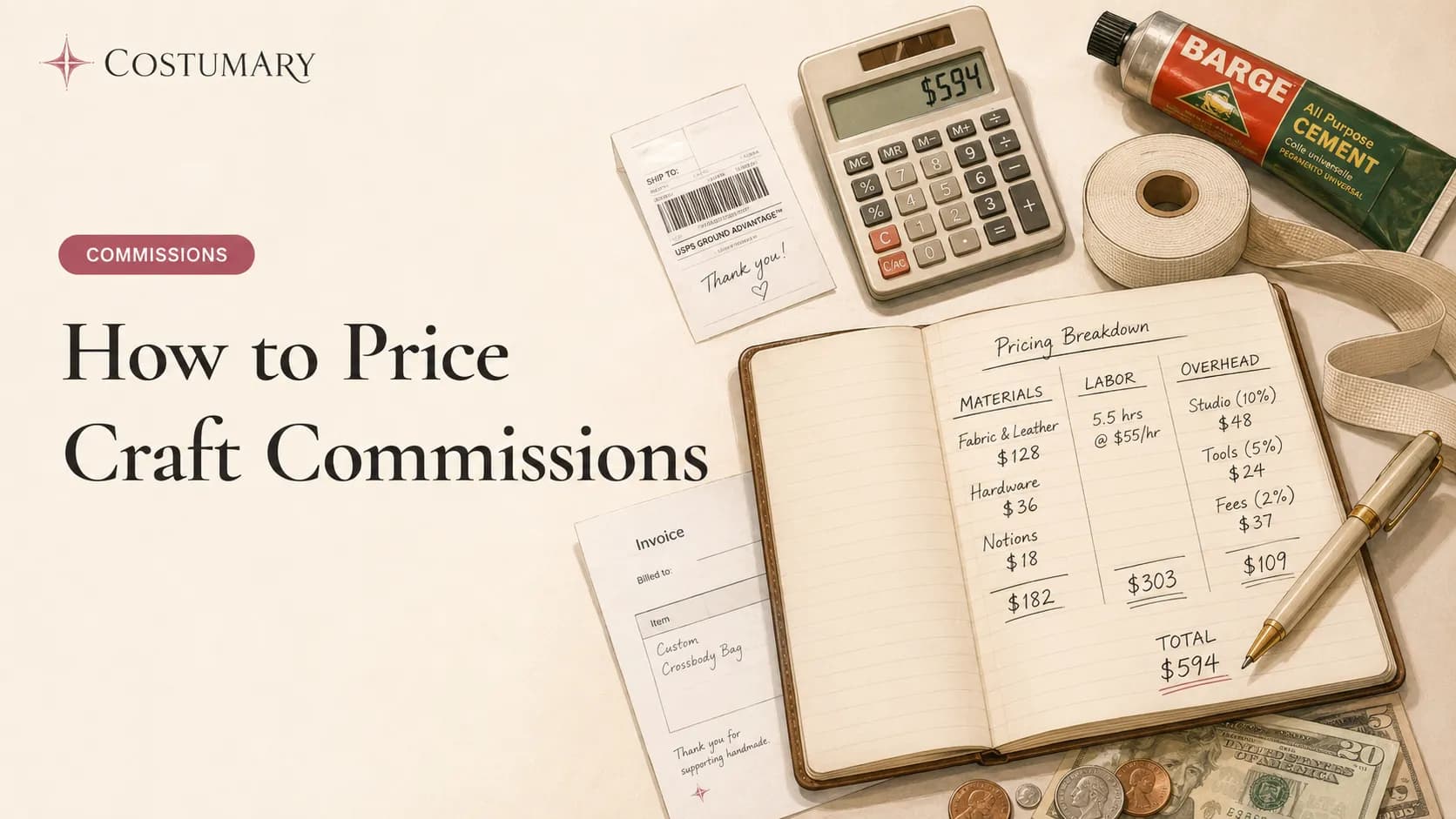
If you're pricing commissions by "what feels fair," you're losing money.
I know because I did it for two years. I'd look at what other makers charged, pick a number slightly below theirs to stay competitive, and call it a day. Then I'd spend 50 hours on a build, subtract my materials, and realize I'd earned $8/hour. My barista job paid more. At least there I got free coffee.
The cosplay and craft commission space has a chronic underpricing problem. Makers pour hundreds of hours into intricate armor sets, fursuits, and props, then charge what "feels reasonable" instead of what the work actually costs. The result? Burnout, resentment, and talented builders quitting commissions entirely.
This guide walks you through the real math behind commission pricing. No guessing, no vibes. Just a formula that makes sure you get paid what the work is worth.
The Commission Pricing Formula
Every commission price breaks down into four components:
Materials + Labor + Overhead + Profit Margin = Your Price
Skip any one of these and you're subsidizing your client's costume with your free time. Let's break each piece down with actual numbers.
Materials: Every Dollar You Spend on the Build
Materials means everything consumed during the project. Not just the big-ticket items like foam sheets and fabric. Everything.
For a mid-complexity EVA foam armor commission, your material list looks something like this:
- 4 sheets of 10mm EVA foam at $14/sheet ($56)
- 2 cans of Plasti Dip at $12/can ($24)
- Barge contact cement ($16)
- Heat-seal primer ($9)
- Acrylic paints ($30-40)
- Elastic, buckles, and hardware ($15-25)
- Sandpaper, replacement blades, and consumables ($10-15)
That's $160-185 before you've cut a single piece. And I'm not even counting the half-sheet of foam you wasted on a pattern that didn't work.
Track every receipt. I use a folder in my phone's photo app. Some makers prefer spreadsheets or our budget calculator to total things up. The method doesn't matter. What matters is that when you quote a project, you're working from real numbers, not memory. Memory always rounds down. (For a line-by-line look at where money goes on a typical armor commission, see the cosplay commission cost breakdown.)
Labor: The Part Everyone Undercharges
Labor is where commission makers get destroyed. "It'll take about 15 hours" turns into 28 hours when you actually track it. I know because I lived that exact delusion on a helmet build.
Your labor cost covers every minute spent on the commission:
- Patterning and prototyping
- Cutting, shaping, and assembling
- Gluing and curing time (yes, time spent waiting for contact cement to tack counts if you can't work on other projects)
- Priming, painting, and weathering
- Test fitting and adjustments
- Client communication and revision rounds
- WIP photography for approval gates
- Packaging for shipping
All of it. Every minute. If you're doing it for the client, it's labor.
To calculate labor cost, multiply your hours by your hourly rate. Which brings us to the question every commission maker wrestles with.
How to Calculate Your Hourly Rate
Your hourly rate isn't what you wish you earned. It's what your skills, experience, and market position justify.
Here's a realistic breakdown by experience level in the cosplay commission space:
| Experience Level | Hourly Rate | Typical Background |
|---|---|---|
| Beginner (0-2 years) | $15-20/hr | Taking first commissions, still building portfolio |
| Intermediate (2-5 years) | $20-35/hr | Consistent quality, repeat clients, established process |
| Experienced (5+ years) | $35-50/hr | Known in community, competition-quality work, full queue |
| Expert/Specialist | $50-75/hr | Masquerade-winning builds, specialized techniques (LEDs, animatronics, complex sewing) |
If you don't know where you fall, try this exercise. Pull up your last three completed commissions. Add up every hour you spent on each one (including emails, revisions, photography). Subtract material and overhead costs from what you charged. Divide the remainder by total hours.
If that number is below $15/hour, you're working for less than minimum wage in most states. That's not a commission business. That's an expensive hobby.
Track your time going forward. Use your phone timer, a free app like Toggl, or just a note on your workbench. Log hours in decimals (4 hours 30 minutes = 4.5 hours) because it makes invoicing math painless. After three or four builds with real time data, you'll know exactly how long things take, and you'll never underbid again.
Overhead: The Invisible Costs
Overhead covers the tools and expenses that don't belong to any single project but make every project possible.
- Tools and equipment: Your Dremel replacement bits ($15/pack, burned through monthly), heat gun tips, sewing machine maintenance, cutting mat replacements
- Workspace costs: If you rent studio space, that's obvious. If you work from home, you're still paying for electricity, ventilation, and the square footage your workshop occupies
- Software and subscriptions: Pattern software, photo editing tools, your website hosting, commission management tools
- Insurance: If you have business insurance (you probably should for anything involving heat guns and power tools)
- Self-employment tax: In the US, that's 15.3% on top of income tax. If you're not setting this aside, tax season will hurt
The standard shortcut is to add 20-25% on top of your materials-plus-labor subtotal. For a commission where materials cost $180 and labor comes to $700 (28 hours at $25/hr), 20% overhead adds $176. That covers the Dremel bits, the electricity, and the tax set-aside without requiring a forensic accounting degree.
Profit Margin: Your Business Growth Fund
Profit margin is not your paycheck. That's labor. Profit margin is the 15-20% on top that lets you buy a new belt sander, survive a slow month, invest in a better workspace, or save for emergencies.
Without profit margin, you're a freelancer living commission-to-commission with zero buffer. One cancelled order or one slow quarter and you're dipping into personal savings.
Add 15-20% on top of the materials + labor + overhead subtotal. This is non-negotiable if you want commissions to be sustainable.
Putting It All Together
Let's run a real example. Mid-complexity EVA foam armor set (chest plate, pauldrons, vambraces):
| Component | Calculation | Amount |
|---|---|---|
| Materials | Foam, adhesive, primer, paint, hardware | $180 |
| Labor | 35 hours x $25/hr | $875 |
| Overhead | 20% of ($180 + $875) | $211 |
| Subtotal | $1,266 | |
| Profit margin | 15% of $1,266 | $190 |
| Commission price | $1,456 |
Before fees and shipping. We'll get to those.
If your gut reaction is "nobody would pay $1,456 for foam armor," check the commission queues of established makers. Beetlecat Originals charges $2,000-$7,000+ for fursuit commissions. Cosplay Dream Team charges $800-$3,000+ for armor sets. The market supports real prices when the quality matches.
Free Tool
Commission Pricing Calculator
Price your commission work fairly. Factor in materials, labor hours, complexity, and overhead to find your rate.
Platform Fees Will Eat Your Margins
If you sell through a marketplace or accept online payments, fees take a bite out of every transaction. Price them in or eat them yourself.
Etsy: The most expensive option for commission makers. Between the $0.20 listing fee, 6.5% transaction fee, and 3% + $0.25 payment processing fee, Etsy takes roughly 10-13% of your sale price. On a $1,456 commission, that's $146-189 gone.
PayPal: 3.49% + $0.49 per transaction for goods and services. On that same $1,456 commission, PayPal takes about $51.
Stripe: 2.9% + $0.30 per transaction. On $1,456, that's about $42. Generally the cheapest option for direct payments through your own website.
The fix: Either build fees into your commission price (add 3-13% depending on your platform) or list fees as a separate line item in your quote. I prefer building them in because clients don't like seeing "processing fee" as a surcharge. But either way, don't absorb them silently. That's money out of your margin. If you're selling through Ko-fi, our Ko-fi commissions guide covers exactly where that platform stops and what to pair with it.
Payment Structures That Protect Both Parties
Never start a commission without money in hand. I made this mistake exactly once. Three weeks into a build, the client ghosted. I had $200 in materials I couldn't use for anything else and zero compensation for 15 hours of work. (If you're dealing with rush orders on top of regular queue pressure, read our guide on rush commission fee pricing for how to structure those without eating the risk.)
Here are the three payment structures that work:
The 50/50 Split (Simple, Clean)
- 50% deposit before you purchase materials or start any work
- 50% balance due before shipping or pickup
Best for: commissions under $800, repeat clients, straightforward builds. Simple to manage, easy for clients to understand.
The 40/30/30 Split (Best for Big Projects)
- 40% deposit upfront
- 30% midpoint payment at a defined milestone (usually after the base structure is complete and WIP photos are approved)
- 30% final payment before shipping
Best for: commissions over $1,000, first-time clients, complex multi-piece builds. The midpoint payment gives clients a natural approval checkpoint and keeps your cash flow healthy on long builds.
The 60/40 Split (Materials-Heavy Builds)
- 60% deposit upfront
- 40% balance on completion
Best for: builds with expensive materials (Worbla, specialty fabrics, LED components) where you need cash upfront to purchase supplies. Especially important if you don't have working capital to front material costs.
Non-negotiable rules regardless of structure:
- Get the deposit before purchasing a single material. No exceptions.
- Set a revision limit in writing (I do two rounds included, $30/hour after that).
- Define what happens if the client cancels. My policy: deposit is non-refundable, partially completed work is billed at my hourly rate.
- Put it all in a written agreement. A Google Doc signed by both parties works. You don't need a lawyer for a commission contract, but you do need something in writing.
Tracking multiple payment milestones across several active builds gets messy fast. The free commission tracker gives you a pipeline view with payment status for every job without requiring a spreadsheet or signup.
When and How to Raise Your Prices
Raising prices feels terrifying the first time. It gets easier. Here are the signals that you're overdue:
Your queue exceeds 3 months. If you're booked out 12+ weeks, demand outstrips your capacity. A 15-20% price increase slows intake to a manageable pace and rewards you for the skills that created that demand. If nobody drops out of your queue after the increase, you didn't raise enough.
Your material costs jumped. Worbla went from $38 to $46 per sheet in two years. EVA foam prices have climbed too. If your raw costs increase 10%+, your prices need to follow immediately.
You added a new skill. When I learned to install programmable LED strips (WS2812B addressable LEDs at $22 per 5m roll), I added a $75-$150 surcharge for illuminated pieces. Resin casting, airbrushing, advanced sewing techniques: each one justifies a rate increase.
It's been 12 months since your last increase. Inflation exists. A flat 5-8% annual increase keeps you from slowly going backwards without shocking your client base.
How to announce it: Post your new rate card publicly at least 2-4 weeks before your next commission cycle opens. "Starting [date], my rates are increasing to reflect [reason]." No apologies. No justification essays. Clients who value your work will stay. Clients who only valued your low prices were never sustainable clients anyway.
The Underpricing Spiral (And How to Break It)
Here's what happens when you underprice. You take on more commissions to compensate for the low per-project earnings. More volume means less time per build. Less time means lower quality or brutal crunch hours. Lower quality means fewer repeat clients. Brutal hours mean burnout. Burnout means quitting commissions entirely and telling everyone "it's just not worth it."
Sound familiar? I've watched a dozen talented makers exit the commission space because of this exact cycle.
The fix is simple (not easy, but simple): charge what the math says, not what feels comfortable. Your discomfort with higher prices is not your client's problem. Your clients aren't asking you to work for $8/hour. You're volunteering.
Run your numbers through the formula. If the price feels high, check your math. If the math is right, the price is right. Trust the spreadsheet over your anxiety.
Still stuck on how to price a specific build? Email us at hello@costumary.com and we'll get back to you within 24 hours.
Frequently
asked questions.
Sources & references
We link to the brands, retailers, and research we reference so you can verify and explore.