Why fursuit commissions are uniquely hard to manage
Fursuits aren't quick turnaround pieces. A single fullsuit takes 150-400 hours across 3-8 months of active work. According to the Fursuit Cost Guide compiled from maker pricing pages, convention surveys, and community forums, the average maker is juggling 4-12 active commissions simultaneously. That means tracking long timelines, expensive materials ($300-800 in fur alone, sourced from suppliers like Howl Fabrics, Furlab Supply, and FursuitSupplies.com), multiple payment milestones, client revisions on ref sheets, and shipping logistics for oversized fragile items.
The typical fursuit maker's tool stack in 2026: Google Forms for intake, Trello for queue tracking, PayPal for payments, Telegram or Discord for client communication, and a Google Sheet for the budget. That's 5 disconnected tools. Payments get lost between PayPal and the spreadsheet. Deadlines slip without anyone noticing until the client asks. A ref sheet update comes in through Telegram but the Trello card still shows the old version.
4–12
Active commissions
Typical queue size for established fursuit makers
3–8 months
Build time per fullsuit
1–3 months for partials, 1–2 months for heads
3–4
Payment milestones
$500–$2,000 per installment on a fullsuit
10–30
WIP updates per build
Photos, approvals, revision rounds
5+
Disconnected tools
Google Forms, Trello, PayPal, Telegram, Sheets
12+
Material types per suit
Fur, foam, resin, mesh, buckram, fleece, dye, adhesive, eyes
Intake: what to collect before you quote
A thorough intake form prevents 80% of disputes. The problem most fursuit makers run into isn't missing questions. It's that the answers live in a silo disconnected from the payment plan, the materials list, and the build timeline.
The minimum intake for fursuit commissions:
Character details: species, markings pattern (symmetrical or asymmetrical), color palette with specific hex codes or fur color matches, eye style (follow-me, toony, realistic, LED), expression (happy, neutral, fierce), jaw type (moving/static/magnetic), ear style (wired, poseable, static), and any special features (wings, horns, tails with armature).
Body specifications: head circumference, shoulder width, chest, waist, hip, inseam, arm length, hand span, foot length, neck circumference, and glasses wearer status (affects head interior). For digitigrade builds, also knee and ankle measurements.
Fur preferences: pile type, color family, and specific supplier preferences. Our fur database catalogs 3,000+ real fur products from 5 suppliers, searchable by pile type and color family, so you can match exact colors from a ref sheet before ordering. This beats the old method of ordering $15-30 swatches from 3 suppliers and hoping one is close enough.
Timeline and budget: hard deadline vs. flexible, budget ceiling, and whether they've commissioned a fursuit before (first-timers need more hand-holding on expectations).
Fur sourcing and color matching
Fur is the single largest material cost in a fursuit build. A fullsuit uses 4-8 yards of body fur at $18-45/yard, plus specialty fur for accents, inner ears, and paw pads. That's $150-400 in fur alone before you account for pile direction, backing stretch, and heat performance.
The traditional approach: email 2-3 suppliers asking for swatches, wait 1-2 weeks, hold them up to your monitor showing the ref sheet, and pick the closest match. If the client's fursona uses 6 colors, you're ordering swatches from multiple suppliers for each one. At $5-8 per swatch set, that's $30-50 and 2 weeks of waiting before you can even quote materials accurately.
The Fur Color Matcher uses CIEDE2000 perceptual color matching across a database of 3,000+ fur products from Howl Fabrics, Furlab Supply, FursuitSupplies.com, BigZ Fabrics, and Stoffhummel, covering most regions. We work regularly with sellers to update listings and keep color accuracy current. Upload a ref sheet, click a color, and see the closest available furs ranked by perceptual distance. It doesn't replace swatching (you should always order a physical swatch before buying yardage), but it narrows your search from "browse hundreds of options" to "order 3 targeted swatches."
The Full Fur Palette tool lets you build a complete palette for a commission: pick all 6 colors, see the closest matches side by side, and export the palette as a project reference. This is particularly useful when a client's fursona uses colors that don't exist in any single supplier's catalog and you need to mix suppliers.
Fur types and their trade-offs (covered in depth in the Fursuit Fur Guide):
Luxury shag ($16-22/yard) is cheap and fluffy but traps heat and pills after 2-3 washes. Mongolian fur ($25-35/yard) has a natural uneven pile that hides seams but is harder to shave for short-pile areas. NFT (National Nonwovens) fur ($30-45/yard) is the gold standard for durability and heat management but costs 2x more. Specialty fur from Howl Fabrics and Furlab Supply offers the best color selection with consistent backing quality.
Pricing: the math behind fursuit commissions
The biggest mistake new fursuit makers make is pricing by "feel" instead of math. A fullsuit that takes 300 hours and $600 in materials priced at $3,000 means you're earning $8/hour. That's below minimum wage in every US state.
The formula: (materials + (hours x target hourly rate) + overhead) x margin. Overhead includes workspace costs, tool depreciation, electricity, shipping supplies, communication time, and platform fees. Most makers forget to include self-employment tax (15.3% in the US) and communication time (10-20% of build hours).
Here's what the market looks like in 2026, compiled from public pricing pages, Fur Affinity commission sheets, and Dealer's Den data:
Fursuit Commission Pricing (2026 Market Rates)

| Type | Price Range | Build Hours | Material Cost |
|---|---|---|---|
| Head only | $800–$2,500 | 60–120 hrs | $150–$300 |
| Mini partial | $1,200–$3,500 | 80–160 hrs | $200–$400 |
| Full partial | $2,000–$5,000 | 120–250 hrs | $300–$600 |
| Fullsuit (plantigrade) | $3,000–$7,000 | 200–350 hrs | $400–$700 |
| Fullsuit (digitigrade) | $4,000–$10,000+ | 250–400 hrs | $500–$900 |
| Refurb / repair | $200–$1,500 | 10–80 hrs | $50–$400 |
Compiled from public pricing pages, Fur Affinity commission sheets, and Dealers Den data (2026).
Platform fees are eating your profit
Platform fees deserve an honest breakdown because every option has real trade-offs.
Fiverr (20%) and Etsy (6.5% + listing fees) charge the most, but they also bring you clients. If you're a new maker with no following, Fiverr's built-in audience and Etsy's search traffic are genuinely valuable. You're paying for discoverability, buyer trust, and dispute resolution infrastructure. For a maker with zero social media presence, that can be worth the cost.
Ko-fi (5%) and VGen (5%) charge less and are popular in art communities. VGen especially is designed for commission workflows. The trade-off is less built-in discovery than Fiverr or Etsy.
Direct platforms (0% platform fee) make sense once you have an established client base through social media, conventions, or word of mouth. At that point, you're paying platform fees for discoverability you no longer need. On a $5,000 fullsuit commission, the gap between Fiverr's 20% ($1,000) and a 0% platform is significant. That's the cost of your fur for the next build.
Most established fursuit makers (according to r/fursuit discussions and Fur Affinity commission sheets) end up on a hybrid model: social media for marketing, a direct commission platform for management, and payment processing through Stripe or PayPal. The platform fee question is really about where you are in your career.
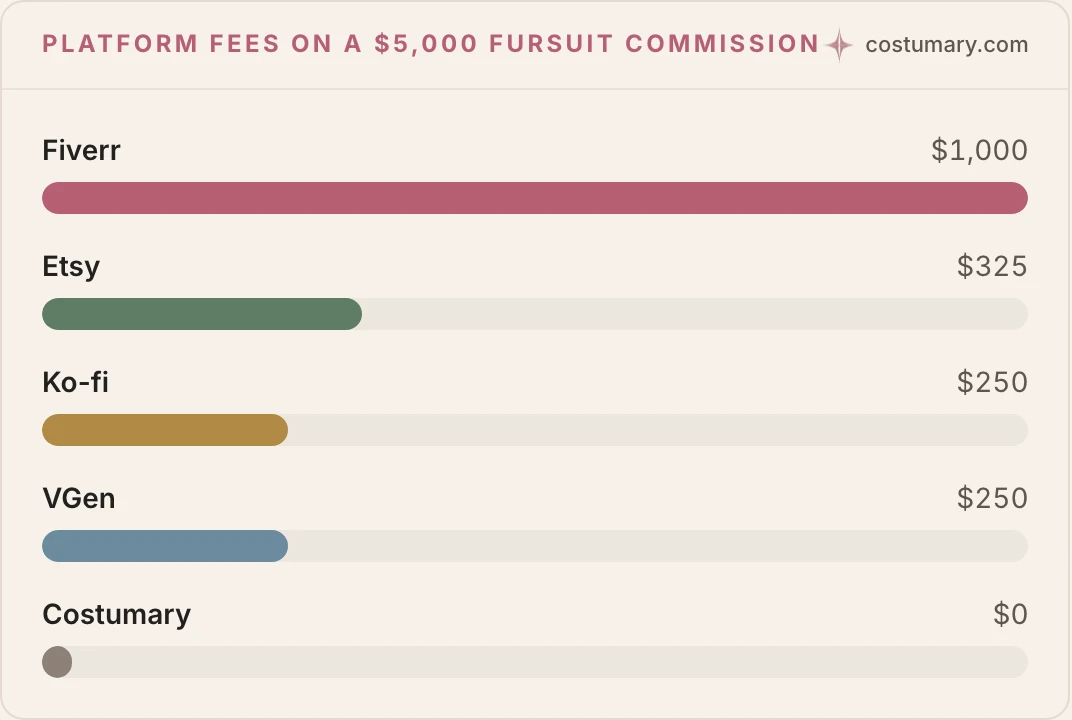
View data table
| Category | Value |
|---|---|
| Fiverr | $1,000 |
| Etsy | $325 |
| Ko-fi | $250 |
| VGen | $250 |
| Costumary | $0 |
Payment milestones that protect both sides
Fursuit commissions are too expensive for single payments. The standard pattern used by established makers (sourced from public TOS pages of 20+ active fursuit makers):
- Fullsuits ($3,000+) — 4 milestones: Deposit (25-50%) at acceptance, non-refundable. Materials payment (25%) when fur and supplies are ordered. Construction payment (25%) at the fitting photo stage. Balance before shipping.
- Partials ($1,200-3,000) — 3 milestones: Deposit (50%) at acceptance. Progress payment (25%) at construction milestone. Balance before shipping.
- Heads only ($800-2,500) — 2 milestones: 50% deposit, 50% before shipping.
- Key rule: Never start materials without at least 50% paid. Never ship without full payment cleared.
- The real challenge: The schedule is easy. Tracking 6-12 of these simultaneously across PayPal, Venmo, and Zelle is where things break. The commission payment tracking guide covers the full landscape of tools.
WIP updates: keeping clients happy without killing your flow
Fursuit clients want to see their character come to life. Based on community expectations documented across r/fursuit and maker TOS pages, here's what clients typically expect to see:
Head build: foam base shaping (3-4 angles), eye test-fit, jaw mechanism test, fur layout before gluing, completed head (front, side, 3/4 view), expression test
Body: pattern mockup on dress form, fur layout, test-fit photos (front, back, side), completed body with head for full look
Extras: hand paws (palm and back), feet paws (sole and top), tail (curved and straight), any accessories
That's 15-25 photo sets per fullsuit build, spread across 3-8 months. The challenge is remembering which client has seen what, which approvals are still pending, and keeping the conversation thread findable months later.
The Telegram/Discord problem: Messages get buried. You can't search for "that photo where they approved the eye color" across 6 months of chat history. If you switch devices, message history can be incomplete. If the client deletes their account, the entire conversation disappears.
The "update tax": Every time you stop building to photograph, edit, upload, and message a client, you lose 15-30 minutes of build momentum. Batch your updates. Photograph at natural stopping points (end of a build session, completion of a major component), not mid-task.
Shipping a $5,000 fragile costume safely
Fursuits are bulky, fragile, and expensive to ship. A fullsuit requires careful disassembly and packing to survive transit.
Packing protocol (refined by the maker community over years of shipping disasters):
Head: Stuff firmly with acid-free tissue paper or clean plastic bags to maintain shape. Wrap the entire head in a plastic bag (protects against rain/water damage during transit). Place in a separate inner box with 2" of cushioning on all sides. The head is the most fragile piece and gets its own box or a dedicated section of the main box.
Body: Turn fur-side-in and fold along natural seams. Place in a large plastic bag. If the body has digitigrade padding, remove or compress the padding separately.
Hands, feet, tail: Each piece in its own bag. Paw pads face inward to protect them. Tail with armature wire should be gently coiled, not bent at sharp angles.
Box: Minimum 24x24x36" for a fullsuit. Use a double-walled box if available. Fill all empty space with packing paper (not packing peanuts, they get stuck in fur). The package should not shift when shaken.
Shipping options and costs (2026 US domestic): - USPS Priority Mail: $50-90 for most domestic shipments. 2-3 day delivery. Insurance up to $5,000 available. - UPS Ground: $60-120. More reliable tracking. Better damage claim process. - FedEx Ground: $55-110. Similar to UPS. - International: $100-300+ via USPS Priority Mail International or UPS Worldwide. Requires customs declaration with accurate value. Some countries charge import duty on goods over $200.
Insurance is non-optional. Insure for the full commission value. Document the packing process with timestamped photos before sealing the box. If a damage claim happens, your photos are the evidence.
Include in the package: printed care instructions (washing, storage, heat management), a small repair kit (matching thread, fabric glue, spare fur swatch), and a thank-you note. These cost under $5 and significantly increase the chance of repeat business and referrals.
Contracts: what to include and what to leave out
A fursuit commission contract should be specific enough to prevent disputes but short enough that clients actually read it. Based on analyzing 15+ public fursuit maker TOS pages, here are the terms that matter:
Scope of work: List every piece included (head, body, hands, feet, tail, accessories). Specify what's NOT included. "Fullsuit" means different things to different makers. If the client wants digi legs, wing attachments, or LED eyes, that's a separate line item.
Timeline: Give an estimate with explicit "not a guarantee" language. "Estimated completion: 4-6 months from deposit. This is an estimate, not a deadline. Actual completion depends on queue position, complexity, and revision rounds." This protects you from clients who treat estimates as promises.
Payment schedule: Exact amounts, due dates tied to milestones (not calendar dates), accepted payment methods, and late payment policy. "Payment is due within 7 days of milestone notification. Builds are paused after 14 days of non-payment."
Revisions: Define what counts as a revision vs. a change order. "Minor adjustments to markings or color placement during construction: included (2 rounds). Structural changes after construction begins (different species, different jaw type, added wings): quoted separately as a change order." Most disputes happen here.
Cancellation and refunds: "Deposit is non-refundable. If cancelled after materials are purchased, materials cost is also non-refundable. Remaining payments are refunded for incomplete work." Some makers offer a prorated refund based on percentage of work completed.
Shipping: Who pays. Who bears the risk after handoff to the carrier. "Shipping is paid by the client. Risk transfers to the client upon carrier acceptance. Insurance is strongly recommended and can be added to the final invoice."
Portfolio usage: "Maker retains the right to photograph the completed suit for portfolio, social media, and promotional purposes unless otherwise agreed in writing." Most clients are fine with this. The few who aren't will tell you upfront.
What to leave out: Don't over-lawyer it. A 10-page contract scares clients away. One page covering the points above is sufficient for commissions under $10,000. For higher amounts, consider having a lawyer review your template.
Manage your commissions in one place
Intake forms, payment tracking, progress photos, client pages, and delivery. 0% platform fees on every commission, forever.