Why cosplay commissions are chaotic to manage
Cosplay commissions span an absurd range: a $50 wig styling, a $300 prop, a $1,500 armor set, a $5,000 full build with wig, contacts, and accessories. Each one has different materials, timelines, and client expectations. Most cosplay commissioners manage everything through DMs, a Google Sheet they update weekly (optimistically), and PayPal invoices that aren't linked to anything. The moment you have more than 3 active commissions, things start falling through cracks.
The typical cosplay commissioner's tool stack (according to r/cosplay and cosplay commission Discord servers): Instagram or Twitter for marketing, Google Forms for intake, Trello or Notion for queue tracking, PayPal for payments, Discord or email for client communication. That's 5-6 disconnected tools, none of which know about the others.
5–10
Active commissions
Typical queue for mid-tier cosplay commissioners
1 week–4 months
Timeline range
Simple prop to full armor + soft parts build
$200–$5,000+
Commission range
Wig styling to full character build
6+
Material types per build
EVA foam, Worbla, fabric, resin, filament, paint, LEDs
5–6
Disconnected tools
Instagram, Google Forms, Trello, PayPal, Discord
2–4
Payment milestones
Per commission on builds over $300
Intake: what to ask before you quote
A good intake form prevents scope creep and expectation mismatches. The minimum for cosplay commissions:
Character details: name, source material (anime, game, film, original design), which pieces are included. Be specific: "armor only" vs "armor + undersuit + wig" is a 2-3x price difference. Reference images are non-negotiable. Official art, existing cosplay photos, turnaround sheets, or a custom ref sheet.
Body measurements: chest, waist, hip, shoulder width, arm length, head circumference (for helmets), and height. For armor, also need bicep and thigh circumference for fit. For bodysuits, inseam and torso length.
Materials and finish: Does the client want EVA foam or Worbla? Painted or vinyl-wrapped? Weathered or clean? These affect price significantly. A clean EVA chestplate is half the labor of a battle-damaged Worbla one.
Deadline: Ask specifically about conventions. "I need it for Anime Expo" means done, photographed, packed, and shipped 2 weeks before the con, not the day before. Factor in shipping time when setting your internal deadline.
Budget range: Some clients have $300 for a full armor set. Knowing this upfront saves everyone time. You can suggest what's achievable at their budget instead of quoting and getting ghosted.
Pricing cosplay commissions by the numbers
The biggest mistake cosplay commissioners make is pricing by comparison ("that other maker charges $800 for a chestplate so I should too") instead of by their own costs. Two makers with the same output can have completely different hourly rates depending on speed, material waste, and overhead.
The formula: (materials + (hours x target hourly rate) + overhead) x margin. Overhead includes workspace rent, tool depreciation, electricity, shipping supplies, self-employment tax (15.3% in the US), and communication time (10-20% of build hours). Most commissioners forget the last two.
Here's what the market looks like in 2026, compiled from commission sheets on Twitter, Instagram, Etsy, and cosplay commission Discord servers:
Cosplay Commission Pricing (2026 Market Rates)

| Type | Price Range | Build Hours | Material Cost |
|---|---|---|---|
| Simple prop | $100–$300 | 10–30 hrs | $30–$80 |
| Complex prop | $300–$800 | 30–80 hrs | $60–$200 |
| Armor set | $800–$2,500 | 60–150 hrs | $150–$400 |
| Soft parts | $200–$1,000 | 20–80 hrs | $50–$200 |
| Full build | $2,000–$5,000+ | 150–300 hrs | $300–$700 |
Compiled from public pricing pages, Fur Affinity commission sheets, and Dealers Den data (2026).
Where platform fees actually matter
Platform fees deserve an honest breakdown because the right choice depends on where you are in your career.
Fiverr (20%) and Etsy (6.5% + fees) bring you clients. If you're new with no social media following, their built-in search traffic and buyer trust are genuinely valuable. On a $1,500 armor commission, Fiverr takes $300 and Etsy takes ~$98. That's real money, but so is the client you wouldn't have found otherwise.
Ko-fi (5%) and VGen (5%) are popular in cosplay art circles. Lower fees, but less built-in audience than Fiverr or Etsy. VGen is better designed for commission workflows.
Direct platforms (0% platform fee) make sense once you have an established client base through social media, conventions, or word of mouth. Most mid-career cosplay commissioners get 80%+ of their clients through Instagram DMs and word of mouth anyway. At that point, platform fees are a tax on discoverability you no longer need.
Most cosplay commissioners (according to r/cosplaycommissions and cosplay Discord servers) land on a hybrid: social media for marketing, a direct platform for workflow management, and Stripe or PayPal for payment processing.
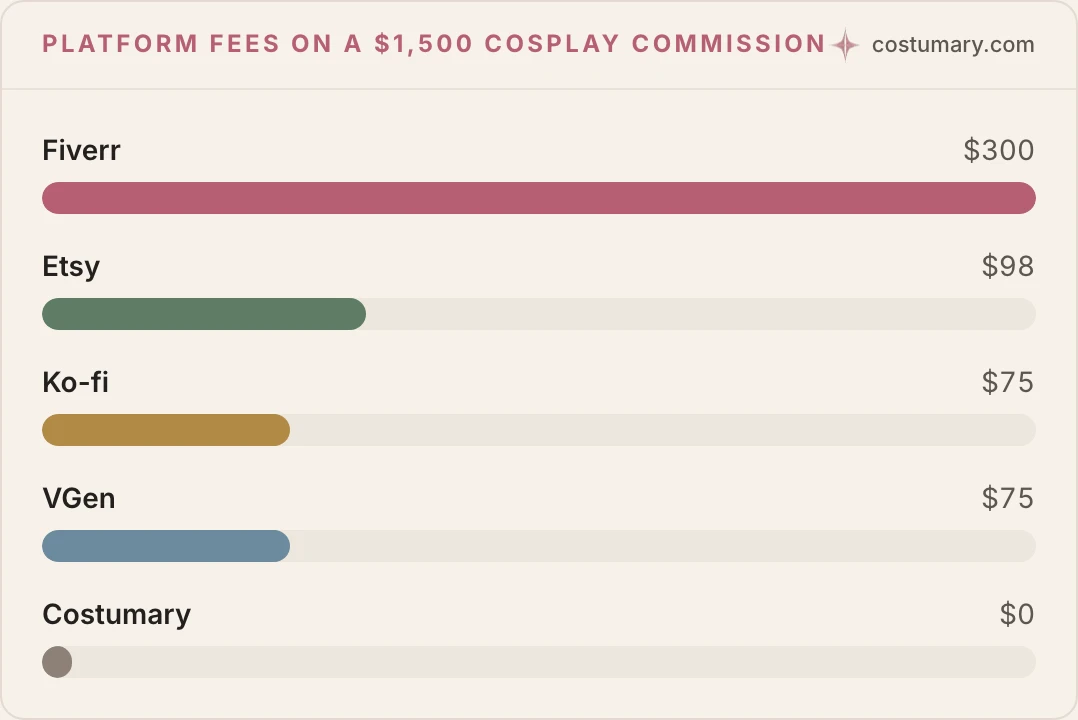
View data table
| Category | Value |
|---|---|
| Fiverr | $300 |
| Etsy | $98 |
| Ko-fi | $75 |
| VGen | $75 |
| Costumary | $0 |
Payment tracking across multiple builds
Small commissions (under $300) are usually paid in full upfront. Anything larger should use milestone payments:
- Props ($300-800) — 2 milestones: 50% deposit, 50% before shipping.
- Armor sets ($800-2,500) — 3 milestones: 50% deposit, 25% at construction milestone (base shapes done), 25% before shipping.
- Full builds ($2,000-5,000+) — 4 milestones: 25% deposit, 25% when materials purchased, 25% at fitting photos, balance before shipping.
- Key rule: Never buy materials without deposit cleared. Never ship without full payment.
- The real challenge: Tracking 5-10 of these at once across PayPal, Venmo, and Cash App. The commission payment tracking guide covers the full tool landscape.
Client updates without the DM spiral
Cosplay clients want to see progress, especially on builds over $500. The pattern that works, based on what successful commissioners post about on social media:
Armor builds: materials laid out, base shapes cut, heat-formed pieces, test fit on mannequin or person, detail work, priming, painting, weathering (if applicable), final assembly.
Soft parts: pattern pieces, muslin mockup, fabric cut, construction progress, fitting photos, finished piece.
The proactive update rule: Send updates before clients ask. A photo at each major milestone reduces "hey, just checking in" messages by 90% and builds trust. Don't wait to be asked.
The platform problem: Conversations started on Instagram DMs six months ago are unfindable. Discord messages get buried under server chat. If you switch phones, email threads fork. The record of what was approved, when, and what version is scattered across apps. Whatever system you use, make sure the approval history is searchable and timestamped.
Packing and shipping cosplay commissions
Cosplay pieces are fragile. EVA foam dents under pressure, Worbla cracks at stress points, paint chips on any contact, and LED wiring can disconnect from vibration.
Packing protocol for armor:
Disassemble into individual pieces. Stuff hollow pieces (helmets, gauntlets) with tissue paper for shape. Wrap each piece in tissue paper, then bubble wrap. Use pool noodles as internal support between large pieces. Box should be 2" larger than contents on all sides. Fill empty space with packing paper (not peanuts, they shift during transit).
Packing protocol for soft parts:
Fold along natural seams, fur/fabric side in. Place in plastic bags to protect from moisture. Roll rather than fold when possible to prevent creases.
Shipping (2026 US domestic): USPS Priority Mail ($30-80 for most cosplay pieces), UPS Ground ($40-100 for oversized boxes). Always insure for full commission value. Photograph the packed box before sealing. Include printed care instructions.
International: $80-250+ depending on size and destination. Customs declarations with accurate values. Some countries charge import duty over $200.
What your cosplay commission contract needs
Based on analyzing commission TOS pages from 20+ active cosplay commissioners:
Scope: List every piece. "Full Tanjiro build" is ambiguous. "Tanjiro haori jacket, black uniform top, black hakama pants, belt, earrings, katana prop (foam, 36"), and wig styled" is not. Anything not listed is a separate quote.
Timeline: Estimate, not promise. "Estimated 6-8 weeks from deposit. Actual completion depends on queue position and complexity." Protects you from clients who treat estimates as deadlines.
Revisions: 2 rounds of cosmetic adjustments included. Structural changes after construction ("actually can you make it Worbla instead of foam?") are change orders quoted separately. This is where most disputes happen.
Cancellation: Non-refundable deposit. If cancelled after materials are purchased, materials cost is also non-refundable. Remaining balance refunded for incomplete work, prorated by completion percentage.
Fit guarantee: You guarantee the piece matches the measurements provided. You do not guarantee measurements the client provided are accurate. Always recommend the client have someone else take their measurements.
Portfolio usage: "Maker retains the right to photograph completed work for portfolio and social media." Standard in the industry. The rare client who objects will tell you upfront.
Manage your commissions in one place
Intake forms, payment tracking, progress photos, client pages, and delivery. 0% platform fees on every commission, forever.