
Full Period Outfit
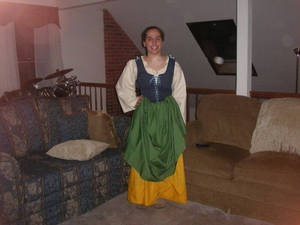
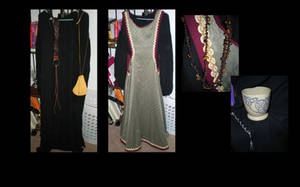
A multi-layer historically inspired ensemble built from the skin out: chemise, structured outer garment (bodice or doublet), lower layers, headwear, and accessories with period-correct details. Eight weeks of intermediate sewing and pattern work, designed for seasoned faire-goers who want a researched, layered look.
8 weeks
10
6
4
See the whole look before you start.
References, materials, budget, and build order for Full Period Outfit.
Timeline
8 weeks
Color refs



Materials
6 items
Budget
$200 - $550
save the visual refs
Full reference board
The preview above is curated for scanning. This is the working board you clone into your own build, with notes, colors, product images, and extra references intact.
Images are sourced from around the internet to help you get started. Use the web clipper to build your own reference library.
Reference images are gathered from around the web and belong to their original creators. We link back to where we found each one. If something here is yours and you want it taken down, email us and it is gone.
Build guide
There's a moment at every faire where you see someone in garb that just hits different. Not flashy, not over-the-top. Just layers that move right, fabrics that catch the light, and details that hold up when you're standing two feet away. That's what a full period outfit gets you.
This is a step up from a basic chemise-and-belt build. You're constructing 3-4 coordinated layers with structured elements, boning or interfacing, period-appropriate closures, and accessories that complete the silhouette. Budget 8 weeks and real fitting time.
Choosing Your Era and Social Class
This decision shapes everything. A 1570s Elizabethan merchant wife wears completely different garments than a 1340s peasant or a 1520s German landsknecht. You don't need a history degree, but you do need a reference folder.
Start with a specific decade and social class. "Tudor middle class" gives you more direction than "medieval." The Victoria and Albert Museum, the Met, and the Rijksmuseum all have free digital collections with paintings that show construction details you won't find anywhere else.
Merchant class is the sweet spot for an intermediate builder: enough layers to look impressive, enough simplicity to actually finish. Court dress involves boning, farthingales or bumrolls, and expensive fabrics.
Fabric Sourcing
A full outfit uses 8-15 yards of fabric across all layers, and fabric choice makes or breaks the look.
Chemise underlayer: linen, $14-18/yard, 3-4 yards. Outer garment (bodice, doublet, jerkin): wool suiting ($15-25/yard) is historically accurate, cotton twill ($8-12/yard) is a solid budget substitute. Court-level builds get brocade or jacquard ($20-45/yard), but it's harder to sew.
Don't forget notions. Lacing cord, eyelets, steel boning for bodices, and woven trim add up fast. Budget $30-50 just for notions.
Building Layer by Layer
Chemise first. Always start with the underlayer because everything fits over it. If your chemise is too bulky, every layer on top sits wrong. A gathered neckline with a drawstring lets you adjust how much chemise shows above the bodice or doublet.
Outer garment second. A bodice or pair of stays requires fitting, boning channels, and eyelets. Use a pattern from Reconstructing History or Margo Anderson, then adjust to your measurements. Make a mock-up in cheap muslin first. Brocade at $35/yard is not where you want to discover your pattern is 2 inches too narrow.
For a doublet, you're working with interfacing, structured shoulders, and hook closures down the front. Pad-stitching the front panels gives that sculptural shape you see in paintings.
Lower garments third. A full gathered skirt (cartridge-pleated for Elizabethan, knife-pleated for earlier periods) is straightforward but fabric-hungry. Expect 4-6 yards for a properly full skirt.
Accessories last. Headwear is the most overlooked element and the one that makes the biggest visual difference. A coif or flat cap takes 30 minutes to sew. A belt, pouch, and character-specific items (prayer beads, keys, eating knife) round out the look.
Closures and Details
Spiral lacing through hand-set eyelets on a bodice looks right and functions well. Hooks and eyes work for layers that need quick removal (useful at the privvy). Buttons should be metal, bone, or wood.
Don't over-trim. Two rows of woven tape on a bodice front reads as "finished." Six rows in different patterns reads as "I bought everything at the trim store."
Fitting All Layers Together
Put on every layer in order and move around for at least an hour. Sit, kneel, reach, eat, drink from a tankard. Check that the bodice doesn't ride up when you raise your arms. Make sure the skirt hem clears the ground (mud at faire is inevitable).
Pack your garb in reverse dressing order: headwear and accessories on top, outer garment next, chemise on the bottom.
Common Mistakes
- Skipping the muslin mock-up. Structured garments need fitting. You will waste more money and time fixing a bad fit in good fabric than you'll spend on $4/yard muslin. Always mock up the bodice or doublet.
- Using modern fabrics for visible layers. Satin from JoAnn's doesn't drape like period silk. It photographs flat and wrinkles wrong. Use natural fibers for outer layers even if it costs more.
- Ignoring the silhouette. A bodice without proper boning or a doublet without interfacing looks like a vest, not a period garment. The structure is what creates the era-specific shape.
- Forgetting headwear. A bare modern haircut over an otherwise perfect Elizabethan outfit breaks the illusion immediately. Even a simple gathered coif takes 30 minutes to sew and costs $3 in fabric.
- Building all the accessories before the garments fit. Get the garb right first. A beautiful hand-tooled belt doesn't help if the bodice doesn't close.
A full period outfit is a season-long project, but it's also one you'll wear for years. Good garb gets better with age, especially linen and wool. Wear it, wash it, and it'll develop a character that no new build can match.
Components
Underlayer (chemise)
Outer garment (bodice/doublet)
Lower garment (skirt/trousers)
Accessories and headwear
Materials list
6 itemsEstimated total cost
$200 - $550
Milestone timeline
8 weeks- 1
Research specific era and social class details
Research
- 2
Sketch full outfit with layer breakdown
design
- 3
Source period-appropriate fabrics and notions
sourcing
- 4
Construct chemise and underlayers
Construction
- 5
Build bodice, doublet, or outer garment
Construction
- 6
Construct skirt, trousers, or overskirt
Construction
- 7
Make or source accessories and headwear
Construction
- 8
Add trim, closures, and finishing
Finishing
- 9
Fit test all layers together
field_test
- 10
Pack outfit by layer order
Packing
Frequently
asked questions.
Related tools and guides
Plan your build, estimate costs, and get ready.
Budget Calculator
Estimate your build cost before you start buying materials.
Convention Checklist
88-item packing checklist. Check off items as you pack.
Prop Scaling Calculator
Scale reference images to your body measurements.
How Much Does Ren Faire Garb Cost?
Real build budgets with specific products and dollar amounts.
Ren Faire on Costumary
Templates, tools, and workspace built for ren faire makers.
Browse all templates
Explore build plans across 10 craft verticals.
Debut your ren faire build
Upcoming conventions where you could wear this. Dates, checklists, and budget tools included.
Maryland Renaissance Festival 2026
Aug 29 - Oct 25 · Crownsville, MD
One of the largest and longest-running ren faires on the East Coast, transforming Crownsville into a Tudor village.
Texas Renaissance Festival 2026
Oct 10 - Nov 29 · Todd Mission, TX
The largest renaissance festival in the United States, running 9 weekends each fall in Todd Mission.
Start this build free
Clone this template into your workspace. Track materials, milestones, budget, and build progress in one place.
Related templates
Leatherwork Project
4 weeks · 8 milestones
A hand-tooled or constructed leather piece for your faire kit: bracers, a belt, journal cover, mug strap, or pouch. Covers veg-tan leather selection, tooling, dyeing with Fiebings, and hardware setting. Four weeks from raw hide to faire-ready gear.
Simple Garb
3 weeks · 8 milestones
Your first faire-ready outfit from scratch: a linen or cotton chemise (or tunic), a leather belt with pouch, and the finishing details that keep you from looking like you raided a Halloween clearance rack. Three weeks, basic sewing skills, under $120.