Props
Cosplay Prop Materials Compared
EVA foam vs Worbla vs 3D printing vs resin casting for cosplay props. Real costs, difficulty, and when to use each material.
The right prop material depends on your prop, your skills, and your budget
Foam for armor. 3D printing for helmets and hard props. Worbla for organic shapes. Resin casting for multiples. That's the short version. The longer version is that each material has real trade-offs, and choosing the wrong one wastes money and time in ways that aren't obvious until you're three days into a build that's headed in the wrong direction.
I've built props for screen-accurate cosplays for eight years, across all four of these materials. I've printed a Halo helmet, cast dozens of resin medallions, built Worbla armor, and made more foam swords than I want to admit. Here's an honest comparison of when each one wins.
For cost planning before you commit to a material, the Craft Build Cost Estimator has prop-specific templates. For the full breakdown of prop material costs by build type, the Prop Making Cost Guide covers it in detail.
Quick verdict by use case
- Armor panels and soft curves: EVA foam
- Helmets, guns, hard-surface props: FDM 3D printing
- Organic shapes, compound curves, detail overlays: Worbla
- Jewelry, small medallions, fine detail props: Resin 3D printing (SLA/MSLA)
- Making multiple copies of a prop: Resin casting
- Budget builds and first props: EVA foam, always
EVA Foam
EVA foam is the easiest and cheapest prop material for beginners, and still the best option for most armor-type props even with experience.
What it is: Closed-cell ethylene-vinyl acetate foam. Available as floor mat tiles (Harbor Freight, $20-25 for a 4-pack) or specialty cosplay foam from TNT Cosplay Supply ($6-12 per sheet).
What you're spending: $5-15 per prop in material costs for average-sized armor pieces. A sword blank runs $8-12 in foam. A full cuirass (chest plate) runs $20-35 in foam material.
What it's best for:
- Armor panels with gentle to moderate curves
- Sword, axe, and blunt weapon props (they're lightweight and safe for con floors)
- Large props where weight matters
- Costumes on a budget
- Beginners building their first prop
Real pros:
- Cheapest option by a wide margin
- Forgiving to cut and reshape. Mistakes cost pennies
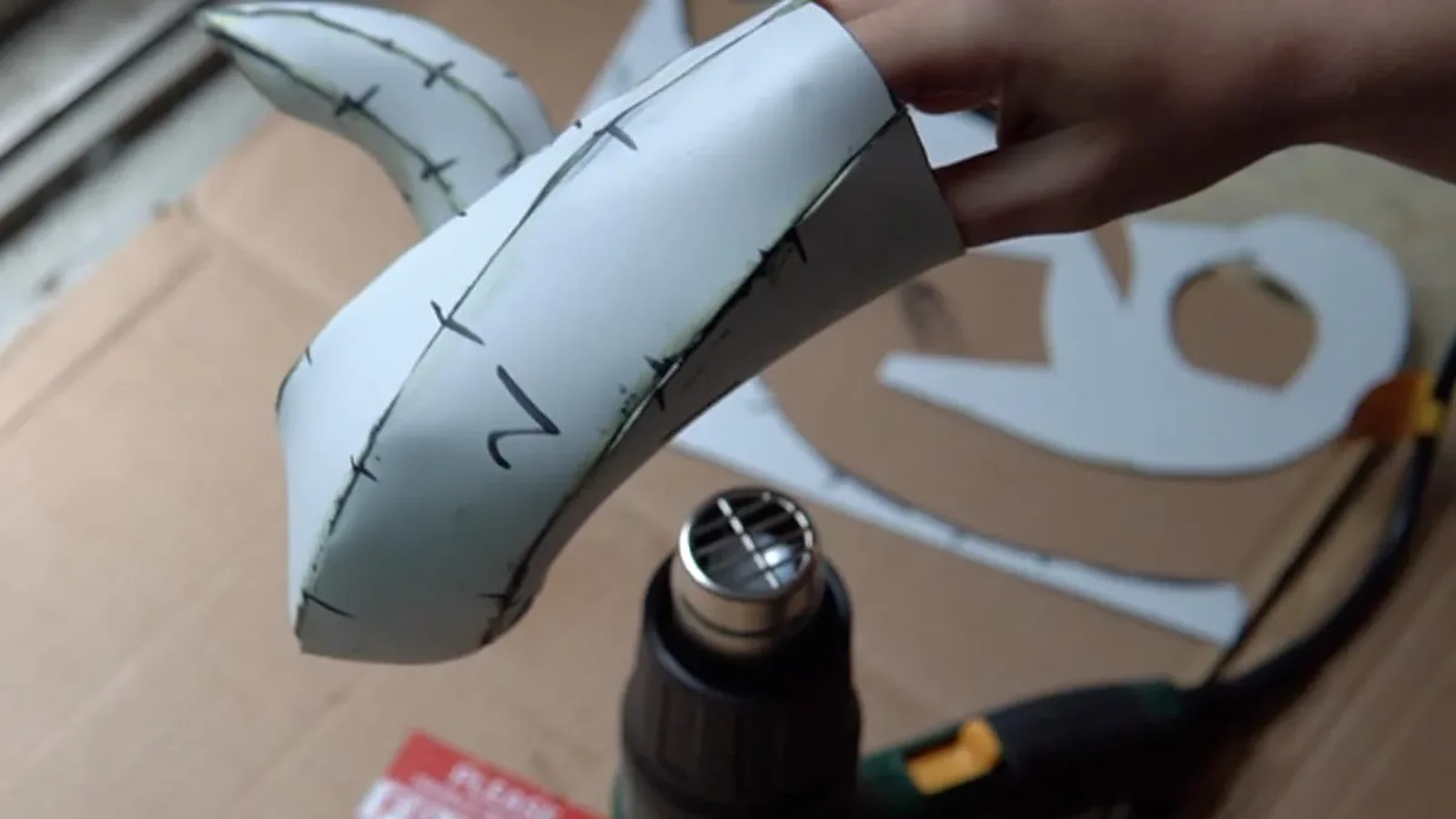
- Heat-shapeable to permanent curves with a heat gun
- Lightweight (full cuirass weighs under a pound)
- Safe for contact and crowded con floors
- Paintable after sealing with Flexbond
Real cons:
- Cannot do fine surface detail. Foam is foam at close range
- Sword blades made from foam look like foam swords. Screen-accurate blades need a different material
- Gets dents and compressions over time with wear
- Won't hold small geometric forms without significant internal structure
Personal experience: My first Mandalorian helmet was foam. It looked great at distance and terrible in photos. The angular geometric shapes of that helmet needed crisp edges that foam can't hold precisely, and every photo taken within 5 feet made the helmet look soft and cheap. Foam was the wrong material for that specific prop. For cosplay armor panels, foam is still what I reach for first. A build like Iron Man's EVA foam armor works well in foam because the panels are large and gently curved, with the hard-surface detail coming from layered foam rather than geometric precision.
Worbla
Worbla is a thermoplastic sheet material that becomes pliable when heated and adheres to itself. It's the premium option for organic shapes that foam can't hold.
What it is: A thermoplastic composite, available in several formulations. Worbla's Finest Art (the original, tan-colored) is the most common. Black Worbla has less texture and a smoother surface straight out of the bag. Both self-adhere when warm, meaning you can press two heated pieces together without separate adhesive.
What you're spending: $25-40 for a standard sheet (about 29" x 39"). A single sheet covers roughly a medium-sized pauldron. A full armor set consumes multiple sheets. Worbla is legitimately expensive.
What it's best for:
- Organic armor shapes with compound curves that foam won't hold
- Detailed surface work, pressed decorative elements
- Over-foam construction (using foam as a base, Worbla draped over for detail)
- Armor that needs to be repositioned mid-build
Real pros:
- Repositionable multiple times while warm. Can rework any section
- Self-adhesive, no separate glue needed for seaming
- Takes acrylic paint well, especially over foam undercoat
- Can be pressed against textured surfaces while warm to add texture
- Stronger than foam under stress
Real cons:
- Expensive. A full armor set requires 4-8 sheets ($100-320 in material)
- Heavy. Worbla is notably heavier than foam for equivalent coverage
- Difficult to sand smooth. The factory surface of Worbla's Finest Art is textured and gritty, requiring multiple coats of gesso or primer to achieve a smooth paintable surface. Black Worbla is smoother but still requires prep work.
- Punishing for beginners. Overheated Worbla stretches and tears. Underheated Worbla doesn't adhere.
- Absorbs and holds heat. Don't wear Worbla armor in direct summer sun without testing.
Personal experience: I used Worbla for a complex shoulder piece on a World of Warcraft paladin costume. The compound curved pauldron looked incredible. The prep time to get a smooth paintable surface took longer than the sculpting. Each sheet of Worbla needed 3 coats of wood glue (cheap smooth primer hack), sanded between coats. Budget at least as much time for surface prep as for shaping.
Smooth primer hack for Worbla: Mix wood glue and a small amount of water, apply 3-4 coats with a foam brush, sand between coats. Cheaper than gesso and achieves a similar surface. I learned this from the Punished Props Academy crew and it's saved me money on every Worbla build since.
3D Printing (FDM)
FDM (fused deposition modeling) printing is the workhorse of screen-accurate prop making. It's what you use when accuracy, hard edges, and fine geometric detail matter.
What you're spending on a printer: The Creality Ender 3 and its variants ($180-250) are the cosplay community's workhorse printer. Dialed-in, an Ender 3 produces excellent results. The Bambu Lab A1 Mini ($300-350) prints faster with less calibration but costs more upfront. For most cosplayers entering 3D printing: start with an Ender 3 or find someone in your community with a printer.
Material cost per print: PLA filament (the standard cosplay printing material) runs $15-25 per kilogram. A full Halo helmet consumes roughly 1.5-2 kg of filament: $25-50 in material. A sword prop is 200-400g: $5-10 in material.
What it's best for:
- Hard-surface props with precise geometry (helmets, guns, sci-fi props)
- Screen-accurate geometric shapes that foam can't replicate
- Props from official or fan-made 3D files (sites like Printables and Thingiverse have thousands of free cosplay files)
- Props you want to be structurally rigid
Real pros:
- Unmatched accuracy for geometric and hard-surface designs
- Scalable by percentage directly in the slicer software (match your exact measurements)
- Files are reusable. Print the same prop again if you need a spare
- Can be painted, primed, and weathered like any other material after post-processing
Real cons:
- Post-processing is 60% of the work. A printed helmet needs extensive sanding (start at 120-grit, work up to 320), gap-filling with Bondo or XTC-3D, re-sanding, priming, and painting. Plan the same amount of time for post-processing as for printing
- Print time for large props is significant. A full helmet: 40-60 hours of print time. A large sword: 20-30 hours. You set it running and wait
- FDM layer lines are visible without post-processing. This is the default appearance, not a defect
- PLA is somewhat brittle. It survives normal wear but drops onto hard floors cause cracks and chips
- Large prints require splitting into sections that must be glued and seamed. A Halo helmet typically prints in 8-12 sections
Personal experience: I 3D printed a Halo Reach helmet over three weeks. 52 hours of print time, 20+ hours of sanding across 4 sessions, Bondo fill, primer, more sanding, paint. The final result was legitimately the most screen-accurate prop I've ever made. Then I dropped it getting off the con shuttle. A section cracked clean through. Foam would have bounced. I've started printing with PETG instead of PLA for props that take handling stress. PETG is tougher and only slightly harder to print.
Scaling tip: Before committing to a full print, look at the Cosplay Prop Scaling Guide for how to accurately scale 3D files to your body measurements. Wrong scale is one of the most common 3D printing mistakes for cosplay.
3D Printing (Resin/SLA/MSLA)
Resin printing uses UV light to cure liquid resin layer by layer. The detail resolution is dramatically higher than FDM.
What you're spending on a printer: The Elegoo Mars 4 or Anycubic Photon Mono run $150-230. Resin itself costs $20-35 per liter. A liter goes fast: small props consume 50-200ml each.
What it's best for:
- Small props where fine detail is critical: jewelry, medallions, small weapons, badge props
- Character-accurate accessories under roughly 6 inches
- Prop components that will be cast in urethane resin for multiples
Real pros:
- Detail resolution is extraordinary. Engravings, fine texture, tiny text all print cleanly
- Layer lines are essentially invisible without post-processing
- Faster than FDM for small parts
Real cons:
- Toxic. Uncured resin is a skin and respiratory irritant. You need nitrile gloves, ventilation, and IPA alcohol for cleaning. This is a real safety requirement, not a suggestion.
- Brittle. Standard resin is more fragile than PLA. For anything that takes handling stress, use ABS-like or tough resin ($5-15 more per liter)
- Limited build volume. The Elegoo Mars print volume is roughly 4" x 2.5" x 5.5". Anything larger requires splitting into sections
- The printer, wash station, and cure lamp together cost $200-350 to set up properly
Resin Casting (Smooth-On)
Resin casting is for making multiples. One master piece, cast into a silicone mold, can produce unlimited identical copies. This is what prop makers, costume makers selling commissions, and anyone running a small production operation use.
What you're spending: Smooth-On's OOMOO 30 silicone mold rubber runs $30-40 for a kit that makes a medium-sized mold. Smooth-Cast 300 urethane casting resin runs $20-25 per trial unit. A complete starter kit for small-batch casting runs $60-100.
What it's best for:
- Making 5+ identical copies of a prop element (armor emblems, sword guards, identical buttons or studs)
- Commission prop makers who need efficient reproduction
- Replicating a master you've sculpted in clay or 3D printed
Real pros:
- Once the mold is made, each copy takes 10-20 minutes to cast
- Copies are identical, which matters for matched sets (pauldron pairs, identical decorative elements)
- Urethane casts paint cleanly and take detail beautifully
Real cons:
- Steep learning curve. Mold making is its own skill set separate from sculpting or printing. Air bubbles, undercuts, and mold release mistakes cause failed casts until you learn the technique
- Two-part resins have limited pot life. Smooth-Cast 300 has a 3-minute working time before it starts curing. You need to work fast
- Urethane resins are isocyanate-based and require proper ventilation and nitrile gloves
- The process only makes financial sense when you need multiples. For a single prop, the mold costs more in time and materials than just building the prop directly
Comparison table
| Material | Cost per prop | Difficulty | Weight | Detail level | Durability | Best for |
|---|---|---|---|---|---|---|
| EVA foam | $5-20 | Low | Very light | Low | Good | Armor panels, weapons |
| Worbla | $25-80 | Medium-High | Medium | Medium-High | Excellent | Organic armor, detailed pieces |
| FDM 3D print | $15-50 + printer | Medium | Medium | High | Medium | Hard props, helmets, guns |
| Resin 3D print | $10-30 + setup | Medium-High | Light | Very high | Low-Medium | Small detail props, jewelry |
| Resin casting | $20-40 + mold | High | Medium | High | High | Multiples, commission props |
Verdict by situation
Not sure which material fits your build? The material wizard asks four questions about your prop and recommends the right material with a thickness guide and glue chart.
First prop ever: EVA foam. The material is cheap, mistakes don't cost much, and it teaches every fundamental technique.
Screen-accurate helmet or hard prop: FDM 3D printing, with a realistic expectation that post-processing will take as long as printing.
Organic armor with complex curves: Worbla over a foam base (foam gives the shape, Worbla gives the detail surface).
Small accessories, jewelry, fine detail pieces: Resin 3D printing with an SLA/MSLA printer.
Selling multiples of the same prop: Resin casting from a Smooth-On two-part kit.
Outdoor event or physical wear testing: EVA foam wins on safety, weight, and durability against impact.
Budget planning for your prop build
For a full breakdown of what these materials cost across different prop types, the Cosplay Prop Cost Guide has itemized estimates by material and complexity. For realistic total cost planning before you buy anything, the Craft Build Cost Estimator includes prop-specific templates for foam, print, and casting builds.
For the prop-making community on Costumary, including templates, build logs, and material recommendations from other makers, check out the Prop Making Hub and the Cosplay Hub.
Frequently
asked questions.
Sources & references
We link to the brands, retailers, and research we reference so you can verify and explore.