Fursuit
How to Make a Fursuit (2026 Guide)
Complete fursuit making guide with real costs, materials, and timeline. From foam head carving to final furring, with honest mistakes to avoid.
Making your first fursuit takes 80-200 hours and $400-1,200 in materials
Here's what nobody tells you until you're elbow-deep in hot glue and fur scraps: the head carving is the hardest part, the furring takes longer than you expect, and your first suit will have visible seams no matter what you do. That's fine. Every experienced maker has a cringe-worthy first build hiding somewhere.
I've made 40+ fursuits over the past eight years, starting with a lumpy wolf head that I'm thankful doesn't exist in photos anymore. This guide covers the full build process from foam base to finished suit, with real costs and the mistakes I made so you don't have to repeat them.
If you want to estimate your total material cost before buying anything, the Craft Build Cost Estimator lets you plug in your suit type and body measurements for an itemized breakdown. For help matching fur colors to a reference image, check the Fur Color Matcher before you order.
What you're actually building
A fursuit has five or six separate components, each requiring different skills. Don't think of it as one project. Think of it as five medium projects that happen to connect at the end.
Head: Carved foam base, covered in fur, with eyes, a nose, and usually a moving or static jaw. This is the skill-check component. Everything you learn here applies everywhere else.
Body: A lycra base layer covered in sewn fur panels. Full suits add arm and leg coverage. Plantigrade bodies (normal human leg shape) are far easier than digitigrade bodies (animal-leg effect with foam padding).
Hand paws: Foam-padded gloves with claws, covered in fur with fleece paw pads.
Foot paws: Built over sandals for indoor events, or sturdier soles for outdoor suiting.
Tail: A stuffed or wire-armature tail attached via belt loop or harness.
Most first-time builders start with a partial, which is just the head, hand paws, and tail. That's the right call. A partial teaches you every core skill without the scope of a full bodysuit.
Materials and what they actually cost
Here's what you need and what to expect to pay in 2026. I've tried to cover both budget and quality options because where you spend matters enormously.
Fur fabric
This is your biggest single expense and the most important quality decision you'll make. Cheap craft fur from a big-box store pills, mats, and looks flat after one convention. You want specialty faux fur from suppliers who cater to the fursuit community.
| Supplier | Price per yard | Best for |
|---|---|---|
| BigZ Fabric | $15-25/yard | Long-pile shag, wide color range |
| Distinctive Fabric | $18-30/yard | Premium pile, consistent quality |
| Howl Fabric | $20-28/yard | Long flow and specialty textures |
| Joann craft fur | $6-10/yard | Budget option, thinner pile |
A partial suit (head, paws, tail) needs 2-4 yards. A full plantigrade suit needs 5-8 yards depending on body size and color count. Multi-color characters need separate yardage per color, which adds up fast.
Buy all your fur at once from the same supplier, same dye lot. I ruined a belly panel on suit number seven because I ordered the "same" white in a second batch and it came out noticeably yellow against the first order. This is a mistake you make once.
Foam
Upholstery foam for head carving runs $30-50 for a block large enough to carve a full head. You want firm upholstery foam, not soft bedding foam. The head base needs enough density to hold its shape after carving.
For a foam base, you'll carve 2-inch thick pieces for the main skull, 1-inch for cheeks and muzzle, and thinner craft foam sheets for detail work. Some builders combine a carved foam base with foam clay for fine details.
Floor mat tiles from Harbor Freight ($20-25 for a 4-pack) work for body armor pieces and foot paw soles. They're lower density than upholstery foam but perfect for anything structural that doesn't need fine shaping.
Adhesives
You'll need two:
Hot glue: For foam assembly and most head construction. Buy in bulk. A head alone eats 25-40 sticks. A $15-20 bag of 100 clear glue sticks is the move. I use a dual-temp gun so I can drop to low heat when working near fur.
Contact cement (Barge brand): For bonding fur panels to foam, joining heavy-load seams, and anything that needs to flex without popping. Barge runs $15-20 at hardware stores. Don't buy it from Amazon: counterfeit Barge is rampant online and doesn't bond the same way. Get it from a local hardware or shoe repair store.
Eyes
The eyes define the entire expression of your character. You have three main options:
Buckram follow-me eyes: Woven mesh fabric with pupils painted on. Your real eyes show through the mesh, creating the "follow-me" effect where the character seems to look at you from any angle. Super cheap: $5 for enough buckram to make several pairs, plus acrylic paint. This is what most makers use.
Resin eyes (DIY cast): A clear domed eye with a printed iris glued inside. More polished look than buckram. DIY casting using clear resin and printed eyes runs $15-30 for materials and makes multiple pairs.
Pre-made eyes: DreamVision Creations sells follow-me and toony eyes starting around $30-80 per pair. Excellent quality. Worth it if you're not confident in your casting skills.
Other supplies
- Balaclava (head base): $5-10
- Pattern paper or newspaper: $0-5
- Scissors and a seam ripper: $10-15
- Hand-sewing needles (heavy duty, curved upholstery needles): $8-12
- Polyester thread in matching colors: $5-10
- Slicker brush (pet store, for brushing out seams): $5-8
- Polymer clay or resin for nose and teeth: $8-20
Total materials for a partial suit: roughly $250-600 depending on fur quality and eye choice. Total materials for a full plantigrade suit: roughly $500-1,000. (For a side-by-side comparison of DIY vs. commission pricing, see the fursuit cost guide.)
Step 1: Make your head base
The head is the hardest component and the one that determines whether people want their photo taken with you or politely walk the other way.
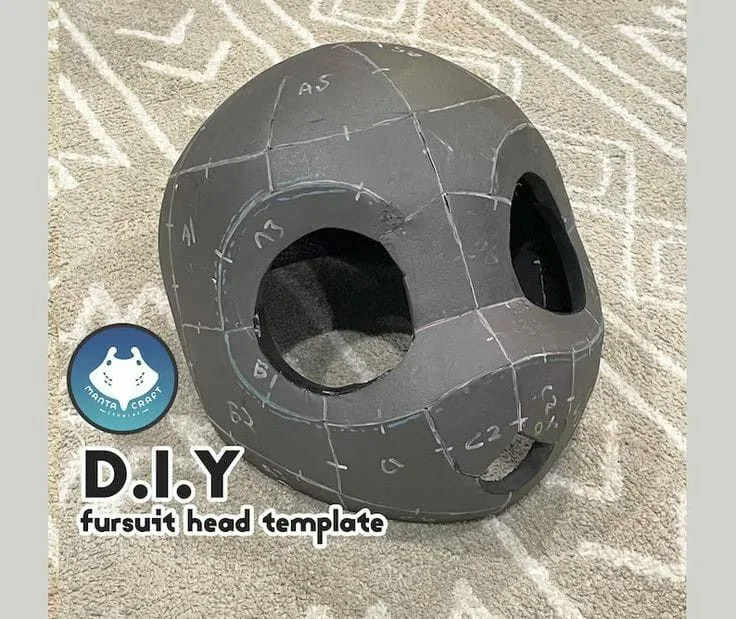
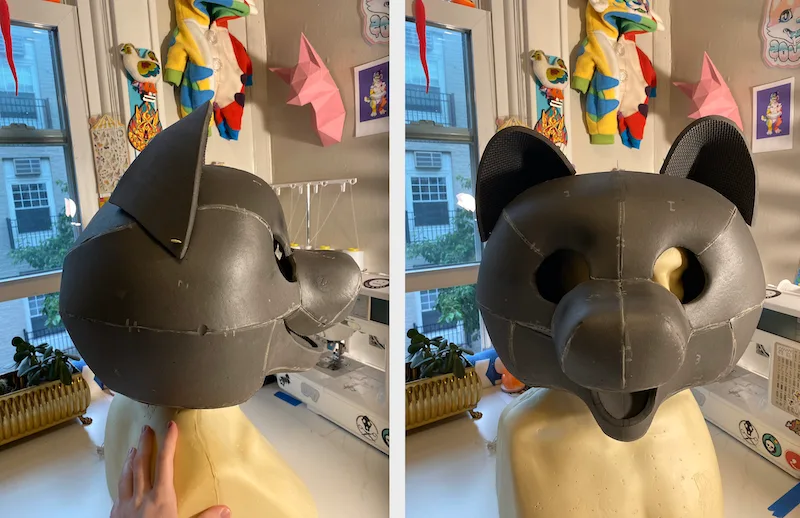
Start with a foam block sized for your head. The core mistake every beginner makes (and I made it too) is carving the foam head too small. After you fur it, the fur pile adds roughly half an inch to three-quarters of an inch all the way around. A head that fits your fist perfectly in foam will be too tight to wear once furred. Carve 1.5 to 2 sizes larger than you think you need.
The basic carving sequence:
- Rough out the overall skull shape with scissors or a serrated bread knife
- Add the muzzle as a separate foam block, shaped and glued in place
- Carve cheek puffs and forehead shape
- Sand the transitions smooth with rough sandpaper (60-80 grit)
- Test fit over a balaclava before gluing anything permanent
Once the base is carved, add the jaw structure. A static jaw is much simpler: just a fixed lower section that creates the appearance of an open mouth. A moving jaw requires a hinge mechanism (usually plastic mesh or flexible plastic sheet) that connects the lower jaw to the head and moves when you open your mouth. I'd recommend a static jaw for your first build.
Install eye sockets last. Trace the eye blank onto the foam, cut the socket slightly smaller than the eye, and pop the eye in with a dab of E6000. The socket should grip the eye without adhesive, with E6000 as a backup.
Step 2: Fur the head
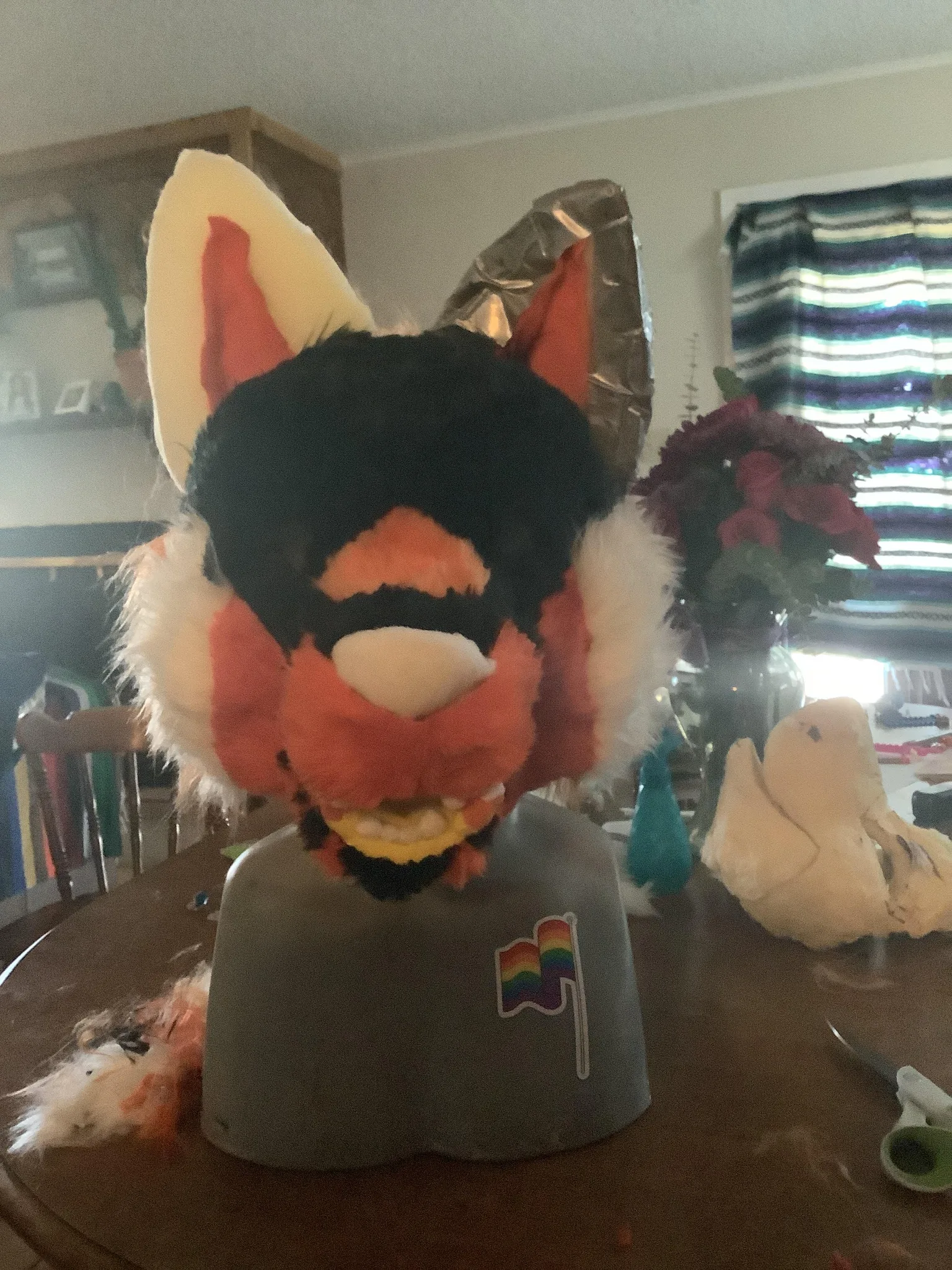
Furring a head is where most first-time builders underestimate the difficulty. You're essentially sewing a 3D fabric skin over an irregular surface, and the fur pile direction controls how the finished character reads from 10 feet away.
The key rule: fur pile runs DOWN on all body parts, BACKWARD (toward the neck) on the head. When fur points backward toward the neck on a head, it lies flat and smooth. If you apply it with the pile running toward the nose, you get a character that looks like it's permanently standing in a windstorm.
For the muzzle, fur often runs toward the nose tip to create the natural look of an animal's face. Watch reference photos of the species you're building before you commit to a direction.
Furring sequence:
- Shave the fur backing to 1/4 inch or less wherever you'll be sewing seams. Full pile makes seams bulky and visible
- Create a paper pattern by wrapping the foam head in masking tape, drawing your panel lines with marker, cutting the tape pattern off, and flattening it
- Cut fur panels with the nap running in the correct direction (cut from the backing side to avoid cutting the pile)
- Sew panels with a stretch stitch or zigzag stitch, wrong sides out
- Turn right-side out, slip over the foam head, and hand-sew the opening closed
- Brush out seams with the slicker brush immediately after sewing
Seams are visible at first. Brush the pile over them firmly in both directions and they'll blend in within a minute or two.
Step 3: Build the body
The body is simpler than the head but more time-consuming because of the sheer surface area. You're essentially making a fur onesie.
The standard method is a duct tape dummy: have someone wrap you in plastic wrap from hips to shoulders, then cover the plastic wrap with duct tape in a tight, overlapping pattern. Cut yourself free (carefully), and you have a 3D form of your torso in the exact shape you need to fill. Draw your fur panel lines directly on the dummy.
From the dummy pattern, you cut fur panels, sew them together, and assemble a fur body shell. The shell gets a heavy-duty separating zipper installed in the back for getting in and out.
For padding: a plantigrade suit sometimes gets chest padding (foam triangles sewn inside the body shell to create a more character-accurate silhouette). Digitigrade builds add foam leg extensions that strap to your lower legs and create the reversed-joint appearance. Digitigrade leg builds add $50-150 in foam and significantly more sewing complexity. Don't attempt digi on your first build.
Step 4: Hands, feet, and tail
Hand paws are built on stretch gloves. Hot-glue foam pads to the backs of the glove fingers for claw placement, glue or sew resin or clay claws at each fingertip, add a foam palm pad, and sew a fur covering over everything. Fleece paw pads go on the palm and finger undersides. Total materials: $20-35 per pair.
Foot paws are built on flip-flops or low-cost sandals for indoor events. Glue foam to the sandal to build up the paw shape, add claw toes, cover in fur, and sew fleece pads on the underside. For outdoor events, glue anti-slip sole material (craft store, $5-8) to the bottom. Total materials: $25-50.
Tails range from a stuffed tube to a wire armature that holds a specific shape. For a simple stuffed tail: sew a fur tube, stuff with polyester fiberfill, and attach a belt loop or D-ring at the base. For a shaped tail, run armature wire down the center before stuffing. Total materials: $15-30.
Realistic timeline breakdown
Here's what to actually expect, not the optimistic estimates you'll see on YouTube:
| Component | First-timer estimate | Experienced maker |
|---|---|---|
| Head (foam carving + furring + eyes) | 50-80 hours | 20-30 hours |
| Body (pattern + sewing + zipper) | 30-50 hours | 15-25 hours |
| Hand paws (pair) | 10-20 hours | 4-8 hours |
| Foot paws (pair) | 12-20 hours | 5-10 hours |
| Tail | 5-10 hours | 2-4 hours |
| Partial total | 65-110 hours | 25-45 hours |
| Full suit total | 107-180 hours | 46-77 hours |
If you've never made a fursuit before, your first build will probably take longer than the top end of these estimates. That's not a failure. You're learning as you go. I broke the hours down by phase, with logged times from working makers, in how long it takes to make a fursuit.
Common mistakes to skip
Carving the head too small. Already mentioned, but worth repeating. The most common first-build mistake by far. Fur adds bulk. Carve big.
Buying fur before you have a finished pattern. Without knowing exactly how many panels you need and in what sizes, you'll either over-buy (wasted money) or under-buy (ordering a second round that might not match the dye lot). Finish your pattern mockup in cheap fabric first.
Using hot glue for everything. Hot glue melts in a hot car and softens at outdoor summer cons. Use Barge for structural seams on the body and anywhere load-bearing. Save hot glue for foam-to-foam joints in the head.
Skipping the shave step before sewing. Unshaved fur at seams creates thick, lumpy ridges that are impossible to hide. Shave the backing to a quarter-inch before sewing any panel edge. Your seam ripper won't thank you if you skip this.
Not testing your vision. Before completing the head, wear it around the house and test your sightlines. Buckram mesh has a limited view angle. If you can't see your feet, you'll walk into people at cons. Adjust the eye placement or enlarge the mesh opening before the head is fully finished.
What I'd do differently
My first head had foam carved so thin at the top of the skull that it dented when I put it on at Anthrocon 2018. I was convinced it was from shipping. It wasn't. I'd carved half an inch of foam over my crown when I needed at least an inch. The dent was from my head pressing up against the fur from inside.
I also used cheap grocery-store craft fur because I didn't know about specialty suppliers. The pile matted within two hours. I spent half the con brushing it out in bathroom mirrors.
Now: I always add more foam than I think I need, buy fur from BigZ Fabric or Distinctive Fabric, and I always make a mockup head in cheap fleece before touching real fur.
Budgeting and tracking your build
Material costs for a full fursuit add up across weeks or months of purchases, and it's easy to lose track. Use the Craft Build Cost Estimator to set up an itemized budget before you buy, then track actual spending against it as you go.
For choosing your fur colors before ordering, the Fur Color Matcher lets you upload a reference image and find the closest faux fur color matches from major suppliers. It's saved me from ordering a fur that looked right on a monitor but wrong against the rest of the suit more times than I want to admit.
For more on the cost side of things, the Fursuit Cost Guide breaks down material costs by suit type in detail. When you're ready to choose between fur types and pile lengths, the Fursuit Fur Selection Guide covers exactly what to look for and what to avoid.
For fursuit makers and other craft builders in the community, the Fursuit Making Hub has resources, templates, and builder tools in one place.
Frequently
asked questions.
Sources & references
We link to the brands, retailers, and research we reference so you can verify and explore.