Fursuit
How to Make a Therian Mask (DIY)
Step-by-step therian mask tutorial with foam base, mesh eyes, and faux fur. Budget-friendly at $20-60 for your first mask.
You can make a therian mask for $20-60 in a weekend
Therian masks are the fastest-growing segment of furry craft right now. TikTok's therian community has driven search volume for DIY mask tutorials to the top of the fursuit craft pile, and most existing tutorials either assume you have a full fursuit toolkit or skip straight to results without explaining the middle steps.
I've made masks using both methods covered here, foam-base and mesh-base, and each has a real use case depending on how you'll wear yours. Let's get into it.
Before you start shopping, the Fur Color Matcher is worth a quick run to find the closest faux fur match to your character's color palette. It compares your reference against colors available from major suppliers so you're not guessing from monitor-to-IRL.
Foam base vs. mesh base: which to make
These are genuinely different projects, not just different aesthetics.
Foam base (traditional fursuit technique): You carve a foam muzzle and skull shape, then fur it. The result is a rigid mask with defined structure. It holds its shape perfectly, looks great in photos, and is more durable. The downside is heat: a foam mask traps more warmth than mesh, and it's heavier to wear for extended periods.
Mesh base (lightweight, outdoor-friendly): You build the shape from wire mesh (aluminum window screen or hardware cloth) formed into the character's head shape. The mask breathes through the mesh, making it significantly cooler. The downside is that mesh bases require more pattern-making skill to get right, and the shape isn't as clean without experience.
My recommendation for first-time builders: start with the foam base. The carving is more forgiving than wire shaping, and the end result photographs better. Come back to mesh after you understand how fur attaches to a 3D form.
What you need (foam base method)
Materials
| Item | Where to buy | Cost |
|---|---|---|
| Craft foam sheets (6mm or 9mm) | Joann or craft stores | $5-10 for a multipack |
| OR upholstery foam block (for more structure) | Fabric store or Amazon | $15-25 |
| Faux fur scraps or small yardage | BigZ Fabric or Joann | $10-15 for scraps, $8-12 for half a yard |
| Buckram mesh (for eyes) | Fabric store or online | $3-6 per yard |
| Acrylic paint + sealant (for eyes and nose details) | Craft store | $5-8 |
| Elastic strap (1-inch wide) | Fabric or craft store | $2-4 |
| Hot glue gun and sticks | Anywhere | $8-15 + $5 for glue sticks |
| Fabric scissors | Own or borrow | : |
| Marker for tracing | Anything you have | : |
Budget tier ($20-30): craft foam sheets, fabric scraps from remnant bins, buckram from a local fabric store, basic elastic.
Quality tier ($40-60): upholstery foam for better shaping, quality short-pile faux fur from BigZ Fabric, resin or acrylic dome eyes instead of painted buckram.
Step 1: Make your base shape
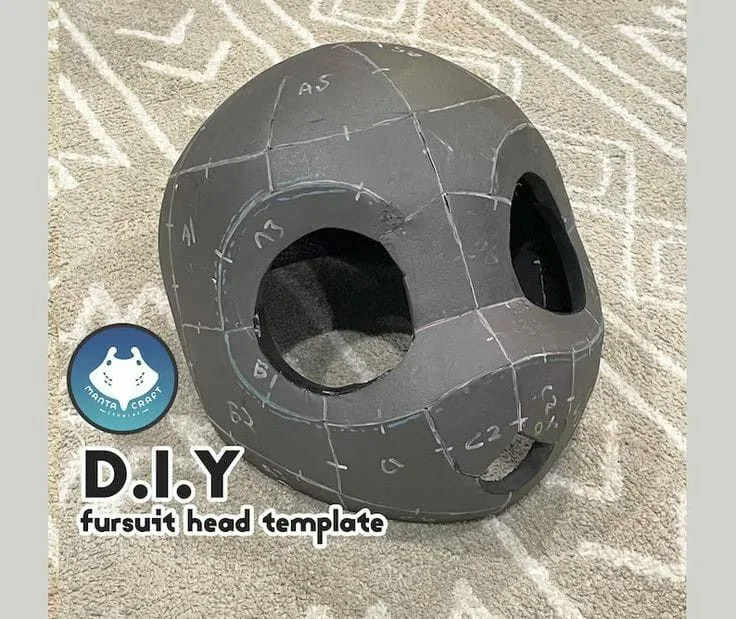
Start with a rough paper template. Wrap your face loosely in plastic wrap (this is easier with a helper). Tape over the plastic wrap with masking tape to create a face cast. Mark the center of your forehead, the tip of where you want the nose, and your cheekbones. Carefully cut it off and flatten it.
This gives you the geometry of your face as a flat pattern. It's not perfect, but it's much more accurate than guessing freehand.
For a foam-base mask:
- Trace the head shape onto craft foam and cut out the side panels, forehead, and muzzle sections separately
- If using craft foam sheets, you'll layer and curve them by scoring the backing lightly (don't cut through) and bending to shape
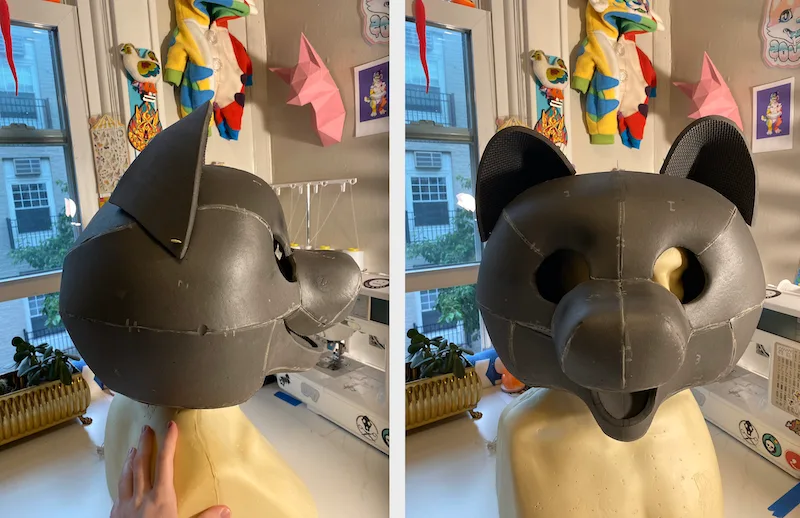
- If using upholstery foam, carve the muzzle block with scissors or a bread knife into an elongated rounded snout shape
Hot-glue the sections together. Common approach: a curved forehead piece, two cheek pieces, and a muzzle that extends forward. The muzzle is the defining feature of the mask. Make it longer than you think you need. After furring, it'll look shorter.
Test fit the base over your face before doing anything else. You should be able to breathe comfortably and see through where you'll place the eye mesh.
Step 2: Build the eye openings
This is where most first-time mask makers run into problems. If your eye openings are too small or placed wrong, you can't actually see well enough to wear the mask safely.
Mark where your eyes are in relation to the base when you're wearing it. The mask eye openings should be 1 to 1.5 inches larger in diameter than your actual eye placement, centered on or slightly below where your real eyes sit. Characters with wide-set eyes look better when you shift the openings outward.
Cut the eye openings in the foam base. Size them generously. You can always add buckram over a large opening; you can't easily enlarge an opening after furring.
For buckram eyes:
- Cut a circle of buckram slightly larger than the eye opening
- Paint the iris and pupil on the buckram with black acrylic paint. Let dry fully
- Seal with a thin coat of Mod Podge or matte sealant
- Glue the buckram circle behind the eye opening in the foam, painted side facing out
For resin dome eyes (more polished look):
- Order pre-made 55mm or 65mm dome eyes from DreamVision Creations or Etsy sellers
- Hot-glue them directly into the eye socket cutouts, or create a socket channel in the foam that holds them snugly
Step 3: Fur the mask
This is the most satisfying step and also where the biggest visible mistakes happen. Two rules:
Rule 1: fur pile runs backward (toward the back of the head). On the muzzle, pointing toward the nose tip. This is how it grows on real animals and it's what looks natural. Fur running the wrong direction makes characters look like they've been caught in a wind tunnel.
Rule 2: use fur that isn't too long. This is the most common therian mask mistake. Long-pile fur (over 1.5 inches) swallows the mask's structure. The muzzle shape disappears. What looked like a defined snout in foam becomes an indistinct fur blob. Use short-pile or medium-pile fur (0.5 to 1 inch) for masks. Keep the long pile for body suits where structure isn't as critical.
How to fur the mask:
- Shave the fur backing to a quarter inch wherever you'll be gluing or sewing seams
- Wrap the mask loosely in paper and trace the individual surface sections: top of head, muzzle sides, muzzle top, chin if applicable
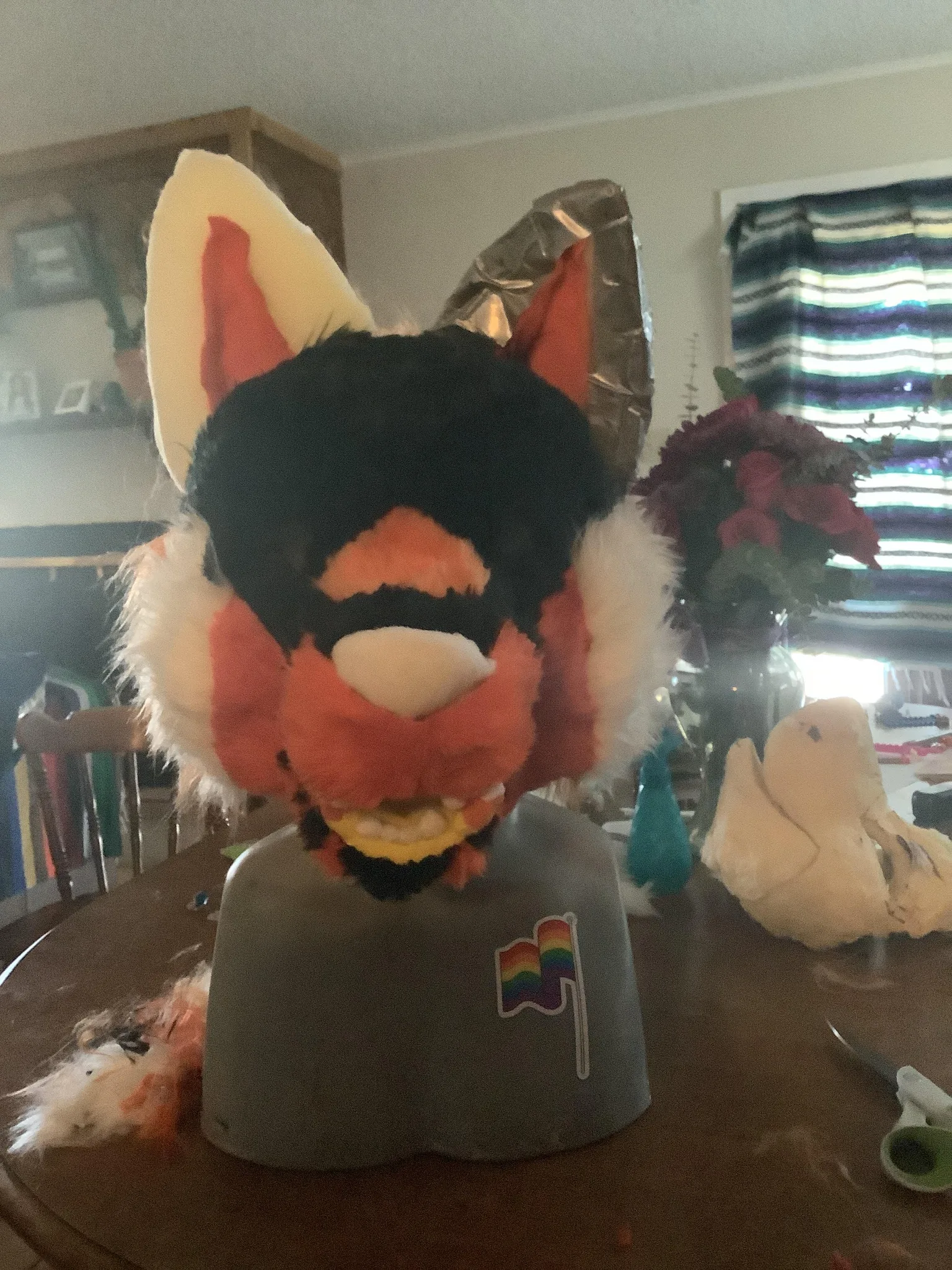
- Cut fur panels from these paper patterns, nap in the correct direction
- Glue panels to the foam with hot glue, starting with the muzzle and working back toward the edges
- Trim and tuck the fur edges under and glue them to the inside of the mask
- Hand-sew or carefully glue where pieces meet to hide the seam
Step 4: Add nose, mouth details, and elastic
Nose: Polymer clay (Sculpey or Fimo, $4-6 at craft stores) sculpted into the nose shape, baked according to package directions, painted with acrylic, and sealed with gloss or matte medium. Hot-glue to the tip of the muzzle. Alternatively, nose blanks are available as pre-cast resin pieces from Etsy sellers for $3-8 per piece.
Teeth (optional): Cast resin teeth from Etsy ($5-10 for a set) or sculpted from clay. Attached to the interior edge of the muzzle opening.
Elastic strap: Measure the elastic to fit snugly around your head at ear level. Sew the ends to the inside edges of the mask at the temples, or create a two-strap setup (top of head + back of skull) for better stability during movement. Two straps hold significantly better if you're doing any activity.
Mesh base method (brief version)
If you want a cooler, lighter mask after your first foam build:
- Use aluminum wire mesh (hardware cloth) bent over a balloon or foam wig head to approximate your head shape
- Shape the muzzle separately and attach with wire or hot glue
- Cover the mesh with a thin layer of buckram or fabric mesh to give the fur something to attach to
- Fur it the same way as the foam method
The main advantage is airflow through the mesh. The main disadvantage: wire edges are sharp. File all cut edges or fold them over before wearing anything near your face.
Common mistakes
Using fur that's too long. Medium-pile fur (under 1 inch) for masks. Long pile is for full suits where the structure is bigger and can carry the volume.
Eye openings too small. You need to see. Err on the larger side and the buckram will hide the opening size anyway.
Skipping the elastic test. Before furring, wear the base with the elastic attached and test it with movement. Jump around. Shake your head. A mask that slips during normal activity will drive you crazy.
Not leaving enough breathing room. If the muzzle is directly over your mouth without clearance, breathing in humid conditions becomes uncomfortable fast. The muzzle should sit 1-2 inches in front of your mouth when worn.
Narrow jaw opening. If you want a wide, toony smile look, cut the jaw opening wider than feels right on the bare foam. Fur narrows the apparent opening when it fills in around the edges.
Tracking your build and budget
For cost breakdowns before you buy, the Craft Build Cost Estimator covers basic to detailed builds. For a fuller look at what fursuits and fursuit components cost to make, the Fursuit Cost Guide has an itemized breakdown by suit type including partials and heads-only builds.
If this mask goes well and you decide to expand to a full partial or full suit, the Fursuit Fur Selection Guide is the guide I wish existed when I started. It covers what to look for in quality fur, what to avoid, and how to evaluate suppliers before ordering.
The Fursuit Making Hub has community resources, pattern links, and tools for makers at all levels.
Frequently
asked questions.
Sources & references
We link to the brands, retailers, and research we reference so you can verify and explore.