Ren Faire
What to Wear to a Renaissance Faire
Three budget tiers for ren faire outfits, from $0 closet builds to $300 quality garb. Real prices, real links, honest opinions from 6 years of faires.
Jeans are fine. But here's everything else.
Let me just say it upfront: jeans and a T-shirt are completely acceptable at a Renaissance faire. Seriously. Nobody will pull you aside, nobody will lecture you, and you will have just as much fun as the person next to you in a full Tudor court gown with hand-sewn eyelets. Faire is for everyone.
But if you're reading this, you probably want to dress up. Maybe you're going for the first time and wondering what's even appropriate. Maybe you went last year in street clothes and this time you want to feel like part of the world. Either way, here's how to spend anywhere from $0 to $300 and look like you belong.
I've been going to faires for six years and finished twelve complete outfits. I've had wildly successful builds and at least two expensive disasters. I'll tell you about both.
The $0 option: closet cosplay that actually works
You don't need to buy anything for your first faire. Most people own pieces that read as vaguely medieval or rustic if you pair them right.
Here's what to pull:
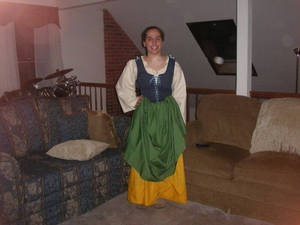
The base layer. A loose white or cream blouse with full sleeves is your best friend. Peasant tops, poet shirts, or any flowy blouse with gathered sleeves will read as a chemise from twenty feet away. If you own a linen shirt in white or off-white, even better. Avoid fitted button-downs or anything with obvious modern logos.
The waist. A wide belt cinched over your blouse transforms it instantly. Brown or black leather belts work best. Even a thick fabric sash tied at the waist does the job. This one accessory is the difference between "person who grabbed a blouse" and "person who dressed up."
The bottom half. A full, flowing skirt in dark colors (forest green, burgundy, navy, brown, black) is ideal for women's garb. Palazzo pants or wide-leg trousers in solid neutrals can work too. For menswear, dark trousers with a tuck-in blouse and vest cover a lot of ground. Avoid athletic cuts and obvious synthetic fabrics if you can.
Footwear. Wear your most rugged, substantial shoes or boots. Ankle boots, Chelsea boots, brown or black leather lace-ups. More on footwear later, but the short version is: skip the sandals.
Accessories. Raid your jewelry box for anything chunky, bronze-toned, or gemstone-adjacent. A pendant necklace, layered chains, or a simple headband adds a lot. Scarves can be tied as headpieces or sashes.
Total cost: $0. Time investment: 20 minutes of digging through your closet.
I've seen people pull this off beautifully. A cream peasant blouse, wide leather belt, dark maxi skirt, and ankle boots is a completely convincing faire outfit. Don't underestimate what you already own.
The $30-80 tier: Amazon and Etsy basics
If you want to buy a dedicated outfit without committing to a real garb investment, the $30-80 range gets you there. This is the tier for people who want something that feels more "costume" than "closet," but aren't sure yet if they'll faire regularly.
What to expect at this price point
Amazon chemises and peasant blouses run $18-35 and are consistently thin. The stitching shows. The fabric is usually a rayon-cotton blend that photographs fine but wrinkles badly by noon. For your first faire, that's completely acceptable. Nobody is inspecting your seams. Wash it before you wear it so it softens up a little.
HolyClothing is the reliable middle option. Their peasant blouses and skirts run $30-60 and are notably better quality than Amazon. The cotton is heavier, the cuts are more flattering, and they size consistently. I owned a HolyClothing top for four years before I replaced it. It's not heirloom garb, but it's not disposable either.
Etsy is excellent at this tier for specific items. Search for "ren faire chemise," "faire skirt," or "peasant blouse" and filter by price. Small shops produce reasonable-quality garb in the $25-50 range, and you support an actual maker instead of a fulfillment warehouse.
A complete $30-80 outfit
| Item | Where | Cost |
|---|---|---|
| Peasant blouse | Amazon or HolyClothing | $20-35 |
| Full skirt or trousers | Amazon or Etsy | $18-30 |
| Wide belt | Thrift store or Amazon | $5-15 |
| Accessories | Thrift store | $3-10 |
| Total | $46-90 |
For a men's outfit at this tier: a poet shirt ($20-35 on Amazon), dark trousers ($20-30), vest or jerkin ($15-25), and a belt. The poet shirt alone sells the look.
Honest warnings about cheap garb
The Amazon corset trap is real and I fell into it. I bought a $25 steel-boned corset for my second faire because I wanted that dramatic silhouette without the dramatic price. By hour three it was digging into my ribs, the plastic boning had bent sideways, and I was seriously considering leaving early. I wore it twice total before I gave it away.
If you want a corset, either buy one that's properly fitted (more on that in the next tier) or skip the corset entirely and do a lace-front bodice instead. A simple boned bodice without the full corset structure is comfortable all day and much more forgiving of sizing variations.
Also: size up on anything with a defined waist or bodice. These garments run small, especially when you're wearing layers underneath.
The $150-300 tier: quality garb that lasts
This is where ren faire investment starts to make financial sense. A well-made garment at this tier will outlast a dozen Amazon purchases and look better every time you wear it.
I replaced my $25 Amazon corset with an $80 custom-fitted bodice from a local artisan at my third Texas Renaissance Festival. She measured me on the spot, explained the construction, and had it finished within two hours. That bodice has been to eight faires. I've never thought about it once while wearing it, which is the highest compliment you can give garb.
Where to shop at this tier
Pearson's Renaissance Shoppe is the most accessible quality vendor at most major faires. Their garments run $80-200 and are made with real fabrics in historically-inspired cuts. Buying at the faire means you can try things on, which matters enormously for fitted pieces.
Armstreet ships from Ukraine and has become one of the most recommended online garb sources in the faire community. Their linen chemises start around $60, dresses run $120-250, and the construction quality is genuinely excellent. Sizing runs true. Shipping takes two to four weeks, so plan ahead.
Local artisans at the faire itself are often the best value at this tier. A maker who's been selling at faires for years has refined their patterns, knows what holds up over time, and can give you fit adjustments on the spot. Prices vary but $80-180 for a bodice or complete outfit is common.
Why quality garb is worth it
A $150 linen outfit from Armstreet or a skilled Etsy maker will still be in your wardrobe ten faires from now. A $40 Amazon set probably won't make it through year two.
Quality garb also layering well. Once you have a good linen chemise, you can add a bodice, then a skirt, then an overdress, building out your kit across seasons without replacing your base layer. That foundation piece pays for itself over time.
Use the Costumary budget calculator to map out a phased build before you buy. It's easy to spend $200 impulsively on pieces that don't work together. Planning first saves money and makes the whole kit more cohesive.
What to wear by character archetype
Peasant or tavern
The simplest, most comfortable, and most universally flattering archetype. Chemise or loose blouse, skirt or breeches, wide belt, practical boots. No jewelry required, though a simple pendant or leather cord necklace adds a lot.
This look is hot-weather-friendly because you're not adding extra layers. For a summer faire, a single-layer linen chemise and skirt is the most comfortable option in the building. I've worn full Tudor court gowns in July and I can tell you: the tavern wench was smarter than me.
Budget range: $0-80 depending on your closet.
Noble or royalty
More expensive and more impressive. You're adding structure (a proper bodice or doublet), better fabric (velvet, brocade, or silk-look), and accessories (jewelry, headpiece, belt with pendant).
A noble outfit at minimum needs: a decent chemise, a fitted bodice or structured overdress, a headpiece, and real jewelry. Budget $150-300 for this look done right.
If you're doing nobility, the headpiece matters more than people expect. A hennin, circlet, or structured hood communicates rank faster than any fabric choice. Etsy has excellent options in the $20-60 range.
Pirate
One of the most popular faire archetypes and for good reason: it's forgiving, theatrical, and fun. The core pieces are a poet or linen shirt, leather or faux-leather vest, dark trousers or a breezy skirt, sturdy boots, and a bandana or tricorn hat.
Pirates are also the most budget-friendly non-peasant option because the "weathered" aesthetic hides cheap fabric choices. Distress everything with sandpaper and tea-staining and it looks intentional.
A note: check your faire's weapons policy before bringing a decorative cutlass. Most faires require peace-tied props, meaning the weapon is visibly secured so it can't be drawn. Some ban them entirely. More on this in the "what not to wear" section.
Witch or wizard
Dark robes, a hood or pointed hat, a staff (if allowed), and as many interesting accessories as you can layer. This archetype rewards thrift shopping because anything dramatic and dark reads well. Velvet cloaks, layered necklaces, rings on every finger.
For a witch look, a full-length dark cloak over a black dress is the base. Add a wide-brimmed hat, chunky silver jewelry, and a reticule or belt bag stuffed with herbs or crystals. Budget $40-100 depending on how elaborate you want to go.
Knight or armored fighter
The most expensive and the hottest option at a summer faire. Plate armor (even the decorative aluminum kind) runs $200-600 or more. EVA foam armor is lighter, cheaper, and can look excellent if painted well, but it still requires real investment in materials and construction time.
If you want a knight look, pair a mail coif or simple helmet with padded gambeson (which reads as armor underclothing) and skip full plate. The look is convincing, the heat is manageable, and you're not spending $400 before you know if you like wearing armor all day.
For anyone seriously interested in armor construction, our LARP armor cost guide breaks down foam and steel builds in detail.
What NOT to wear to a ren faire
Weapons: check before you go
Every faire has its own policy and they're not consistent. Most allow peace-tied props (weapon is tied or zip-tied so it can't be drawn). Some require inspection at the gate. Some ban realistic-looking weapons entirely. Some allow live steel for participants in certain activities.
Check the specific faire's website before you arrive with anything that could be mistaken for an actual weapon. Showing up with a katana and getting turned away at the gate is a bad start to the day.
Corsets: break them in first
If you're wearing a new corset for the first time, do not debut it at faire. Break it in at home for two or three sessions of two to three hours each before wearing it all day in the heat while walking uneven ground. A corset that hasn't been worn in has inflexible boning and no give at the stress points. You will be uncomfortable by 11am and miserable by 2pm.
I know this from personal experience. My first real corset was a beautiful thing from a local maker and I wore it for the first time to a 7-hour faire day. I made it to hour five before I had to find a car and loosen everything. She had told me to break it in. I didn't listen. Don't repeat my mistake.
Shoes: please, not sandals
Faire grounds are not paved. They're grass, gravel, dirt, wood chips, and mud depending on the weather. By 3pm your feet will have covered four to six miles. You will stand in lines, stand watching performers, and stand browsing vendor stalls.
Flatform sandals, dress sandals, flip-flops, or anything you'd wear to brunch will destroy your feet by early afternoon. Wear leather boots, ankle boots, or substantial flats with real arch support. If your boots aren't broken in, add a gel insole. Your future self will thank you.
I wear Trotters leather oxfords to casual faire days and a pair of actual turn-shoes I made for more dressed-up events. The turn-shoes look incredible and are the most comfortable thing I own for all-day walking because they're leather-soled and mold to your feet. They took me about 6 hours to make and cost $45 in leather. Worth every minute.
Sun exposure and coverage
Faire is primarily an outdoor event and you will be in direct sun for most of the day. Anything that leaves large expanses of your back, shoulders, or chest exposed is a sunburn risk. A beautiful off-the-shoulder peasant blouse that looks great in photos will leave you with a stripe sunburn by 4pm.
Either cover up with a cloak, shawl, or overdress, or apply sunscreen religiously before and during. I carry a small SPF 50 spray in my belt bag for reapplication. It fits between my snacks and my coin purse.
My real first faire experience (the unfiltered version)
My first faire was Texas Renaissance Festival in 2019. I drove three hours, wore a chemise I'd made in a weekend from $14 of muslin, a thrifted brown skirt, and boots I already owned. I felt completely out of place for about ten minutes and then forgot to feel that way because there was a jousting tournament and someone handed me a turkey leg.
My second faire I wore the $25 Amazon corset I mentioned earlier. By hour three I was cursing the person who designed it. By hour four I'd untied half the lacing and was holding it together with a hair tie behind my back. I looked fine from the front. From the back I looked like I'd lost a fight with a lace-up shoe.
For my third faire, I found a local maker in the vendor stalls and spent $80 on a properly fitted front-lacing bodice. She adjusted the fit while I stood there and I've worn it to five faires since. That was the most money I'd ever spent on a single costume piece and it was absolutely the right call.
The progression was: closet cosplay, cheap internet purchase that didn't work, quality piece that fixed the problem. Most faire-goers go through some version of this cycle. I'm telling you now so you can potentially skip the middle step.
If you're building out a full kit, the Costumary ren faire garb cost guide has detailed fabric and material pricing for DIY builds. And if you're trying to figure out how much yardage you'll need for a specific pattern, the fabric calculator does the math.
Planning your faire wardrobe across multiple events
Don't try to build a complete outfit for your first faire. Pick one archetype, build the most essential pieces, and wear it. See what's comfortable, what bothers you, and what you wish you had. Then add to it for the next faire.
The faire garb approach that works:
Faire 1: Closet cosplay or a single $50 outfit. Go observe what other people are wearing. Note what you love and what you see a lot of.
Faire 2: Add one quality piece to what you already have. A good bodice, a proper cloak, boots you bought specifically for this. Budget $60-100.
Faire 3: Add accessories and finishing touches. A belt bag, a circlet, a period-correct hat. Budget $30-60.
By faire three, you have a cohesive kit that you assembled thoughtfully, spent $150-200 total, and actually fits your body because you made adjustments between events.
For tracking your outfit costs and planning future builds, Costumary has tools specifically for faire makers and garb builders. The circle skirt calculator is especially useful for the most common faire skirt construction. If you're planning a con trip alongside faire season, the convention budget planner helps you track what you've spent and what you still need.
Start with what you have. Add what you love. The garb grows with you.
Frequently
asked questions.
Sources & references
We link to the brands, retailers, and research we reference so you can verify and explore.