Miniature Painting
Managing Your Miniature Pile of Shame
Your unpainted backlog isn't shameful, it's a planning problem. How to track, prioritize, and actually shrink your pile of grey plastic.
I have 347 unpainted miniatures. I know because I counted.
Before I counted, the number was "a lot" and I kept buying more because I couldn't see the damage. A Combat Patrol box here, a Start Collecting there, a limited edition character I'd definitely get to eventually. The pile grew because the pile was invisible.
Once I knew the number, I stopped buying for three months. Not out of willpower. Out of the simple fact that 347 felt like enough.
This guide is about making your backlog visible. Not to make you feel guilty about it, but to give you the information you need to manage it like a planning problem instead of a shameful secret.
"Pile of shame" vs "pile of potential"
The community term is "pile of shame" and the self-deprecation is part of the culture. But shame isn't a useful management framework. It makes you feel bad when you buy, feel bad when you look at unpainted models, and feel bad when you don't have time to paint. That's a lot of bad feeling for a hobby you're doing for fun.
I prefer "pile of potential." Not as a cope, but as an accurate description. Every unassembled kit is a future painting session, a future game, a future shelf display. The only actual problem is when the pile grows faster than you can work through it indefinitely, which eventually turns into a lot of money sitting idle on a shelf.
Visibility turns the pile from an emotional burden into a logistical one. Logistics are solvable.
Why backlogs grow
New releases create buying pressure that's almost entirely decoupled from your actual painting throughput. Games Workshop releases new Combat Patrols, character models, and army box sets on a regular cadence. The releases are time-limited or produced in limited quantities. The buying decision is made under social and temporal pressure.
Painting is the opposite of that. Painting takes 40 hours for a well-finished 1,000pt army. Buying takes 40 seconds on the Games Workshop website.
Combat Patrol boxes are specifically good value, so the math always seems to justify another one. The box at $170 contains models worth $250-300 if bought individually, so you're "saving" money by buying a box you haven't finished the last one from. This is how most backlogs grow: individually rational decisions that combine into an unreasonable total.
FOMO is real in this hobby. Limited edition models, exclusive character sculpts, army box sets that won't be restocked. The fear of missing out on a release you might want later is a genuine psychological pull that Games Workshop's marketing understands and leverages. Buying eliminates the anxiety immediately. Painting does not.
Count by model, not by box
Most backlog estimates are wrong because people count boxes. A Combat Patrol is not "one purchase." It's 20-25 models.
Go through your hobby storage and count individual models. Every infantry figure, every vehicle, every character. Use a spreadsheet, a notes app, or Figure Case to log each unit. The real number is almost always worse than you think.
I thought I had "about 200" miniatures before I counted. I had 347. The extra 147 were in the back of boxes I hadn't opened and in small impulse purchases I'd forgotten about. The counting process itself is informative because it forces you to actually look at everything.
For a financial perspective on what that backlog represents in actual dollars, run your collection through the Army Cost Calculator. The number is usually $300-800 at retail value sitting idle. That's 2-4 more Combat Patrols worth of plastic doing nothing.
For a deeper look at what miniature hobby spending actually costs over time, see Warhammer Army Cost Breakdown.
How to track your backlog
Pile of Potential app is designed specifically for this problem. You log each model or kit, assign it a status, and can share your collection publicly. It's free, focused, and the simplest option if you just want to track progress without a lot of setup. The social sharing creates optional accountability: posting your pile publicly and then shrinking it over time becomes a motivating narrative.
Figure Case is broader than Pile of Potential. It covers stages from Wishlist through Finished, and the additional granularity (Unassembled vs. Assembled vs. Primed vs. In Progress) is useful if you batch process stages. A session of clipping and assembling moves 10 models from Unassembled to Assembled even if you don't prime them the same day. Seeing that movement is satisfying.
A spreadsheet works and you won't update it. I've tried twice. The problem with spreadsheets for hobby tracking is that they require you to think about your hobby like a project manager, which is the wrong mode when you've just finished a painting session and want to close everything down. The barrier to updating needs to be low.
Costumary lets you create a project per army or project type, track milestones (assembled, primed, basecoated, finished), see completion percentages, and attach reference photos. It also connects budget to project progress, so you can see what an army has cost you alongside where it is in the painting pipeline. It's the right tool if you're managing multiple armies and want financial visibility alongside progress tracking. For that combination, use the Budget Calculator alongside the project view.
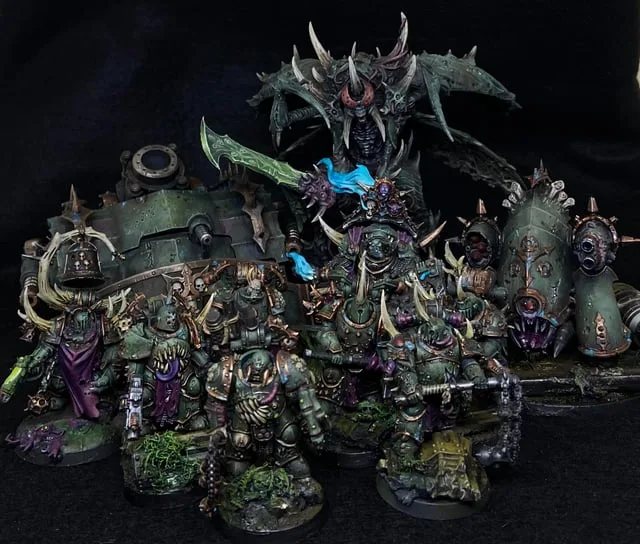
Physical shelf organization is the simplest possible system. Keep two shelves: grey plastic (unpainted) and finished (painted). When the grey shelf gets bigger than the painted shelf, stop buying until the balance shifts. No app required. The visual comparison is the feedback loop.
For a broader look at starting a new Warhammer army with realistic expectations, see Warhammer Starter Army Guide (2026).
Rules that work
These come from the hobby community. Some are strict, some are gentler. Pick the one you'll actually stick to.
Finish before you buy. Complete one box before opening the next. This is the hardest rule and the most effective one. "Finish" means assembled, primed, painted to tabletop standard, and based. Not "mostly done." Done. This rule fails when you hit a hard kit or a boring unit, so it works best for people who genuinely enjoy the painting process and not just the collecting part.
One in, one out. Buy a new kit, finish an old one first. Gentler than finish-before-buy because it lets you buy on release day as long as you have a completed kit to match it. This keeps the backlog from growing while still letting you participate in new releases.
Army first. Pick one army, finish it to 2,000 points fully painted, then start another faction. This prevents faction-hopping, which is the most common backlog accelerant. Starting a second army while the first is half-done means you now have two half-finished armies and twice the pile to feel bad about.
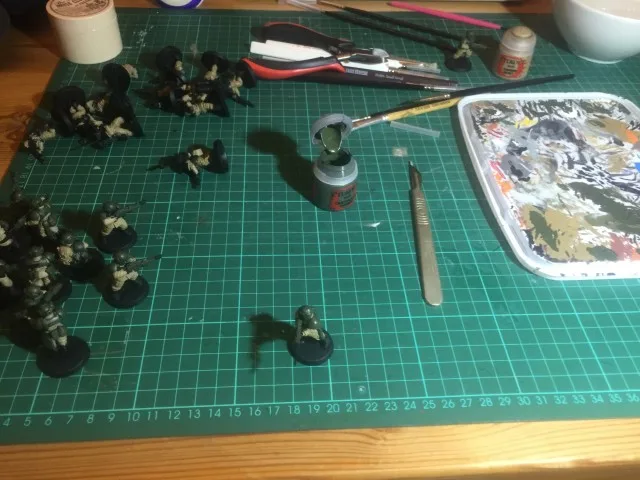
Batch painting discipline. Painting 10 models of the same type at once is faster per model than painting them one at a time. It's also more boring. The discipline is to stay in batch mode even when you'd rather work on something more interesting. Assembly-line painting (base all 10, shade all 10, highlight all 10) develops a rhythm that makes large units feel achievable rather than endless.
Kill Team as pressure relief. One box, 6-10 models, a complete playable game in a weekend of effort. Kill Team scratch-builds the satisfaction of a finished project without committing to a full army. When your main army is stalled on 30 infantry who all need the same shade and you're losing momentum, a Kill Team side project gives you a completable win.
The social accountability loop
Posting painted miniatures on r/minipainting or Instagram creates positive feedback that the pile does not. The community celebrates finished minis enthusiastically. A post showing 10 completed Intercessors gets upvotes, kind words, and genuine hobby energy. A post showing 10 grey Intercessors on a shelf gets "nice, can't wait to see them painted."
The asymmetry is motivating. Painting gives you something to share. The pile doesn't.
Some painters run public "pile of shame" tracking threads where they post their total count monthly and the community watches the number go down. The accountability is optional but real. If you've told 200 people your backlog is 347 models, starting a new army becomes a public decision.
The money angle, honestly
A backlog of 347 models at average retail represents roughly $600-900 in Games Workshop MSRP. At discounted prices, maybe $450-650. Either way, that's real money sitting on a shelf unpainted.
I'm not suggesting this should make you feel bad. I'm suggesting it should factor into your buying decisions. Before you add to the pile, knowing the dollar value of what's already there changes the calculation from "I can afford another Combat Patrol" to "I have $600 of unfinished work already."
The miniature painting supplies cost guide has a complete breakdown of what paint, brushes, and tools cost alongside model prices, which helps you see the full investment your hobby requires.
What happened when I instituted "finish before you buy"
I started this rule in January. My backlog went from 347 to 280 in five months. I finished a full Necron army (40 models, based and varnished), a Grey Knights Kill Team (10 models), and 20 Thousand Sons infantry. None of those were fast projects.
I also saved $400 because I wasn't buying on impulse. When a new release dropped, I looked at my shelf, confirmed I wasn't close to finishing anything, and didn't buy. The rule made "not buying" feel like the correct choice rather than a deprivation.
280 models is still a lot. But 280 with a system feels different from 347 with a vague sense of dread.
For tracking everything in one place, the Warhammer Army Planner and for/minipainting hub are good starting points for organizing your hobby workflow beyond just the backlog.
Frequently
asked questions.
Sources & references
We link to the brands, retailers, and research we reference so you can verify and explore.