Miniature Painting
Track Paint Recipes for Miniatures
How to record miniature paint recipes so you can match colors across batches. Apps, notebooks, and photo methods compared.
The $40 mistake I keep making
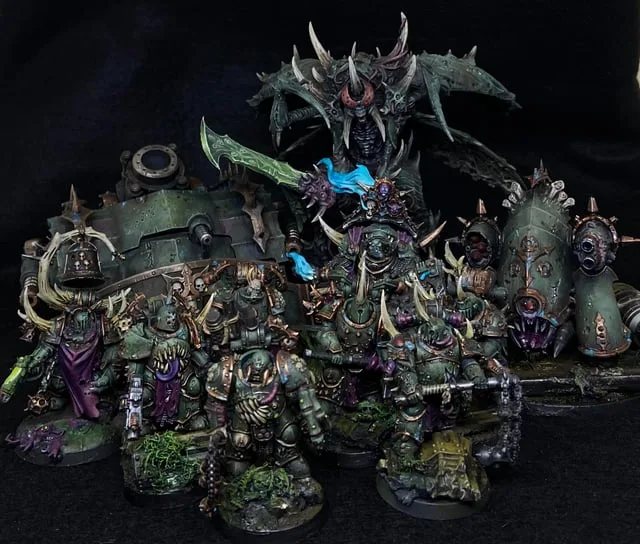
I painted 20 Intercessors in a custom blue scheme last March. In September I added 10 more. They don't match. The highlight is wrong and I can't figure out if it was Hoeth Blue or Lothern Blue or some mix of both. The whole squad looks slightly off and it bothers me every time I look at the shelf.
That's a $40 mistake in time and paint. And it's entirely my fault for not writing anything down.
If you've painted long enough, you've done this. You find a scheme you love, paint 20 models, close the case, and six months later your muscle memory has completely evaporated. This guide is about not doing that anymore.
Before you start your next project, run the Paint Scheme Planner to sketch your scheme and generate a shareable record before you pick up a brush.
Why recipes get lost
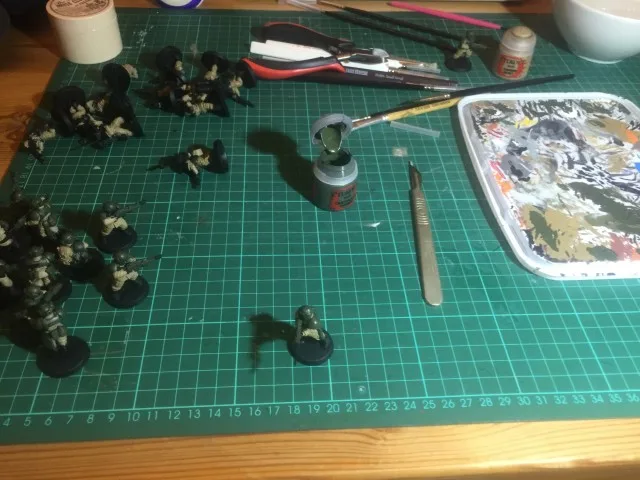
You paint in flow state. The best sessions are the ones where you're not thinking about the process, you're just moving through it. Base coat, shade, layer, highlight, done. You don't stop to write notes because stopping breaks the rhythm.
Six months later the session exists only as a photo of finished models and a vague sense of "I think it was Macragge Blue as the base." You go back to Macragge Blue and the new batch looks slightly different from what you remember. You add the highlight and it's too bright. You add a glaze to knock it back and overcorrect. You're now three hours in trying to match something you painted in 90 minutes the first time.
The fix is simple and costs five minutes per session. Most people don't do it because those five minutes feel like friction when you're in the middle of painting. They're not. The friction is six months from now.
What to record for every scheme
A complete paint recipe captures enough information to reproduce the result exactly, including the specific techniques and not just the color names. Here's what belongs in every recipe card.
1. Model and photo. Write the unit name and include a photo of the finished result. Not the in-progress shot, the final photo. You need a visual target, not just a paint list.
2. Primer color and brand. Primer changes how every paint looks over it. Army Painter Uniform Grey gives different results than Citadel Chaos Black even with identical paints on top. Record the brand, the color, and whether it was spray or brush-on.
3. Base coat with thinning ratio. The base coat is the most important step to record precisely. Include the brand, color name, whether you thinned it and with what, and roughly how many coats you applied. "Citadel Macragge Blue, slightly thinned with water, two coats" is specific enough to reproduce. "Blue base" is not.
4. Shade or wash. Which product, how diluted, and how you applied it. There's a significant difference between flooding all-over, applying only to recesses with a fine brush (recess wash), and pin washing specific details. Note which method you used. Citadel Nuln Oil Gloss in recesses behaves differently from the same wash applied all-over.
5. Layer and highlight sequence. List each highlight color in order, from darkest to lightest. Include how much edge or surface you're covering at each step ("thin edge highlight only" vs "broad highlight on raised panels"). Two or three colors is typical. Record all of them.
6. Special techniques. If you used glazing, drybrushing, stippling, sponge weathering, or salt weathering at any point, write it down with enough detail to reproduce it. "Light drybrush of Citadel Ironbreaker with a medium brush" is specific. "Drybrushed silver" is not.
7. Basing recipe. Texture paint brand and color, any secondary materials (sand, cork, rocks), tuft type and color, and the rim paint color. Bases tie an army together visually. A mismatch between old and new bases is as jarring as a mismatch in the armor color.
Where to keep your recipes
You have options. Here's an honest assessment of each.
paintRack is the best dedicated recipe tool available. The premium tier lets you build step-by-step recipe cards linked to your paint inventory, so you can see at a glance whether you still own everything you need for a previous scheme. The cross-brand matching feature is useful when a specific pot is discontinued. The weakness is that paintRack has no photo attachment for in-progress shots, and the UI isn't optimized for complex multi-step recipes with technique notes.
Paint Pad has cleaner recipe UX than paintRack. The step ordering is drag-and-drop, you can add photos at each stage, and the finished card reads like a tutorial you actually want to follow. I use Paint Pad over paintRack specifically for recipe recording, then keep paintRack for inventory. Having two apps for this is slightly annoying but worth it for the better recipe UI.
A physical notebook works surprisingly well if you also photograph the page. Low tech, high reliability, immune to app deprecation. The risk is that a handwritten notebook doesn't travel well to conventions or games, and photos of handwritten pages are harder to search than text. If you're the kind of person who writes things down and actually keeps the notebook, this is a valid choice.
Notes app on your phone is fine for one army. By the time you're managing three armies with different schemes, searching "blue highlight" in an unstructured notes file returns ten partial results and nothing useful. This works until it doesn't, and it stops working faster than you expect.
Costumary project notes let you attach recipes to specific projects with reference photos, milestone tracking, and budget visibility. The limitation is that Costumary isn't paint-inventory-aware, so you can't search by color or find cross-brand equivalents. It's a good place for the final complete recipe tied to a project, but not for day-to-day paint lookup. For managing a full project's materials and costs alongside your recipe, see the Army Cost Calculator for the budget side and the miniature painting supplies cost guide for what to expect to spend.
The back of the box. Don't. You'll throw it away. I have thrown away the back of boxes. Everyone has thrown away the back of a box.
The batch matching problem
Even with a perfect recipe, you might not be able to reproduce the exact result. Citadel paint formulas vary slightly between production batches. Your 2024 pot of Macragge Blue might mix slightly differently than a 2026 replacement. This is real, documented in the community, and there's no perfect solution.
The best mitigation is to record thinning ratios and highlight percentages rather than treating colors as exact targets. "Macragge Blue thinned 1:1 with water" gives you more reproductive precision than "Macragge Blue." "Highlight with 70% Calgar Blue, 30% Macragge Blue" is more reproducible than "Calgar Blue highlight."
For projects where color consistency matters across time (ongoing armies, commission work), buy enough paint at the start to finish the army. One pot of Citadel base paint covers roughly 20-30 infantry models. A squad of 10 uses about a third of a pot. Buying two pots at the start is cheaper than the time cost of matching a discontinued or reformulated batch later.
A recipe card template you can copy
This is the format I use. Copy it into whatever app or notebook you're using.
Unit: [Name and faction]
Date: [When you painted it]
Photo: [Attach reference photo]

Primer: [Brand, color, spray or brush]

Base coat: [Brand, color, thinning ratio, coats]

Shade: [Brand, color, application method (all-over / recess / pin)]

Highlights:
  1. [Color, surface coverage]
  2. [Color, surface coverage]
  3. [Color, edge only]

Special techniques: [Glazing, drybrushing, stippling, etc.]

Base:
  Texture: [Brand and color]
  Additions: [Sand, cork, rocks]
  Tufts: [Type and color]
  Rim: [Color]

Notes: [Anything non-obvious about the technique]
The photo trick I wish I'd known earlier
I now photograph my wet palette before I clean it at the end of every session. One photo captures every color I mixed that session, the consistency of each mix, and roughly how much of each I used. It's not a substitute for a proper recipe card, but it's a fast backup that's saved me twice when I forgot to write something down.
The photo timestamps itself and stores automatically in my camera roll. If I painted something on a Saturday in April and I need to know what I used, I can find the palette photo in about 30 seconds.
For the best brushes and tools to use while you're painting, see Best Miniature Painting Tools (2026) for what's actually worth buying at each price point.
The investment in five minutes
A complete recipe card takes five minutes to fill out after a painting session. That five minutes will save you hours when you need to add more models to a finished squad. It'll save you the frustration of staring at a painted model trying to reverse-engineer your own work.
More than that, it builds a personal library of schemes that you can adapt and reference across projects. My recipe library has 40+ cards now. When I start a new army, I look through old recipes for technique approaches I can adapt rather than starting from zero.
Start with your current project. Fill out one card tonight. The habit builds from there.
For the full picture of paint costs and what to budget for your hobby supply list, see the miniature painting supplies cost guide and the for/minipainting hub for resources organized by experience level.
Frequently
asked questions.
Sources & references
We link to the brands, retailers, and research we reference so you can verify and explore.