Miniature Painting
Warhammer Starter Army Guide (2026)
Real costs for starting a Warhammer army in 2026. Combat Patrol prices, hidden supply costs, and where to save 20-30% on models.
A playable 1,000pt starter army costs $250-400 at retail. Here's how to spend less.
I painted my first Warhammer miniature in 2015. It was a Necron Warrior with a silver drybrushed carapace and a wash of Nuln Oil. It took me 45 minutes and looked fine from two feet away. I was immediately in over my head.
I've since painted Blood Angels, Grey Knights, Thousand Sons, and a Chaos Daemons warband. I've seen the hobby from both sides of the money question: the moment when you think you're buying a $170 box and the moment when you realize you're actually committing to a $400 project. This guide exists so you can make that calculation with your eyes open.
Before we get into specific boxes and faction costs, run your list through the Army Cost Calculator. It'll help you estimate the full price of your chosen faction before you click anything.
Quick verdict
A playable 1,000pt starter army costs $250-400 at retail and $180-300 from discount retailers. Combat Patrol boxes are the best value per model. The box price is not your total cost: add $80-120 for paints, brushes, tools, and primer if you're starting from zero. Your first army plus all supplies runs $350-550, not the $170 printed on the Combat Patrol box.
If you're only going to read one section, that's it.
What is a Combat Patrol?
Combat Patrol is both a product and a game format. The product is a discounted starter box that includes 15-25 models worth around $250-300 if bought individually. The format is a sub-1,000pt matched play mode designed for 45-minute games. You can buy a Combat Patrol box, assemble and paint what's inside, and immediately play Combat Patrol games with other starter-box armies. It's the best on-ramp the hobby has ever had.
You don't need 2,000 points to start playing. Kill Team needs one box (sometimes two small ones). Combat Patrol is a real game format. 500pt games against friends are real games. The pressure to buy a "full army" before you touch the hobby is a community myth that Games Workshop's marketing is more than happy to reinforce.
Cost breakdown by faction
All prices below are 2026 MSRP from Games Workshop and approximate discounted prices from retailers like Miniature Market (typically 15-20% below MSRP).
Space Marines Combat Patrol
MSRP: $170 | Discounted: ~$130 | Models: ~25 | Points: ~500
The safest starter choice because Space Marines have the deepest tutorial library on YouTube, Reddit, and the Warhammer Community site. Nearly every painting guide assumes Primaris proportions. The downside is that half your local game store is playing Space Marines in some sub-faction, which matters if you care about being the only person at the table with your army. The Combat Patrol includes Intercessors, a Redemptor Dreadnought, and an HQ choice, which is a solid nucleus for expansion.
Necrons Combat Patrol
MSRP: $170 | Discounted: ~$130 | Models: ~20 | Points: ~500
This is what I started with and what I still recommend for absolute beginners. Necrons are the most forgiving faction to paint because the easiest technique (metallic spray primer, single shade wash, optional drybrush highlight) produces genuinely good results. There's no skin to worry about, no complex cloth, no fiddly gems if you don't want them. Spray Leadbelcher, wash Nuln Oil, drybrush Ironbreaker, and you have tabletop-quality miniatures in an afternoon. The Necrons Combat Patrol includes Warriors, Scarabs, a Doomsday Ark, and an Overlord.
Tyranids Combat Patrol
MSRP: $170 | Discounted: ~$130 | Models: ~25 | Points: ~500
Tyranids are a batch painter's faction. Lots of models, organic shapes, and they reward a simple three-color scheme with a gloss varnish over the chitin plates. The Combat Patrol includes Termagants, a Broodlord, Ripper Swarms, and a Screamer-Killer. Good choice if you want to learn speed painting techniques because you'll be painting 20+ identically colored creatures and you need to get efficient fast.
Orks Combat Patrol
MSRP: $170 | Discounted: ~$130 | Models: ~30 | Points: ~500
Orks give you the most models per dollar of any faction. Thirty-something models in a Combat Patrol box, lots of character and visual interest, and the forgiving quality standard of "they're Orks, they're supposed to look messy." The downside: assembling Boyz is tedious and repetitive. You'll clip 180+ individual arms before you're done. Good for someone who wants to learn assembly but with a faction that's aesthetically tolerant of beginner mistakes.
Death Guard Combat Patrol
MSRP: $170 | Discounted: ~$130 | Models: ~20 | Points: ~500
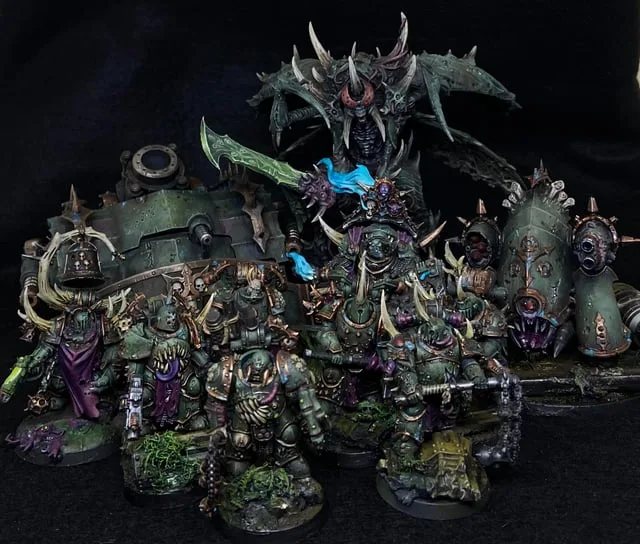
Death Guard are Chaos Space Marines dedicated to Nurgle, and their aesthetic is deliberately corroded, rusted, and disgusting. That's a gift for new painters because weathering hides imperfection. A stippled rust effect and a Seraphim Sepia wash over the pale armor color makes even rough brush work look intentional. The Combat Patrol includes Plague Marines, Poxwalkers, a Malignant Plaguecaster, and a Biologus Putrifier. These models have the most complex surface detail of any faction I've listed, but the painting style rewards that complexity.
Age of Sigmar starter considerations
Age of Sigmar runs cheaper than 40K at the army level for most factions because models are typically fewer and points values are different. A Stormcast Eternals or Nighthaunt Combat Patrol equivalent runs $140-160 instead of $170. If the fantasy setting appeals more than science fiction, AoS is a slightly lower barrier of entry with an equally deep painting community.
Hidden costs nobody mentions on the product page
This is the section the hobby forums wish they'd had on day one.
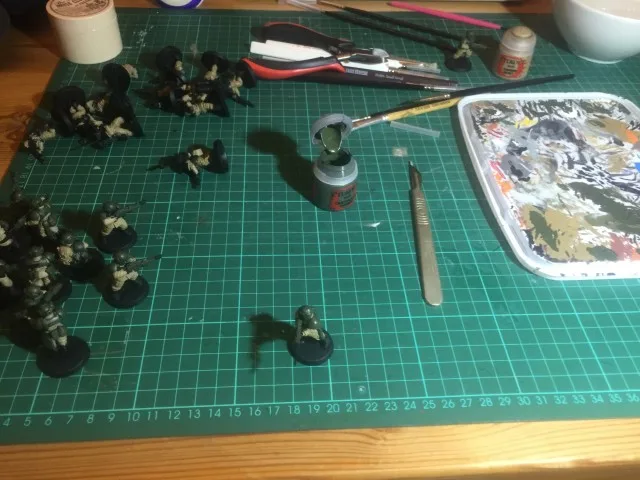
Paints: $35-120. The Combat Patrol box includes zero paint. A Citadel Essentials set ($35) includes 11 pots and covers the basics. A more complete starting range runs $80-120. The Citadel app's guided paint steps help beginners spend less time on paints they won't use.
Brushes: $15-40. You need at least three: a basecoat brush (flat, size 3-5), a detail brush (round, size 0 or 1), and a drybrush. Army Painter or Citadel starter sets work fine. Don't buy expensive sable brushes until you've learned not to leave paint drying in the ferrule.
Clippers (sprue cutters): $8-15. Models come attached to plastic frames called sprues. You need clippers to remove them. Do not use scissors. Do not use your hobby knife as a lever. The Tamiya sharp clippers ($15) are the best budget option and last years.
Hobby knife: $5-10. For removing mould lines (the thin ridges from the casting process) and trimming gates. A basic X-Acto knife with spare blades works fine to start.
Mould line remover: $8-10. Optional but useful. A dedicated mould line scraper from Games Workshop or generic hobby suppliers makes the prep step faster and less hand-cramping.
Plastic glue (not super glue): $6-8. Warhammer plastic models bond chemically with plastic glue, creating a weld rather than a surface bond. Tamiya Extra Thin is the standard recommendation. Super glue works in a pinch but creates weaker joints for polystyrene plastic.
Spray primer: $8-15 per can. One can covers 20-30 infantry models. You'll need at least one before painting anything. Citadel's Chaos Black and Corax White are the standard options. Grey Seer is useful if you're painting bright color schemes. Rust-Oleum 2x matte primer works as a budget substitute at $6-8 per can.
Cutting mat: $10-20. Protecting your desk and giving your hobby knife a proper cutting surface. A basic self-healing mat from any craft store works.
Basing materials: $10-20. Sand, texture paint, static grass, tufts. You can skip this at the start, but bases matter more than people tell you. A well-based miniature looks complete. An unbased model on raw black plastic looks unfinished regardless of how well the paint job is done.
Total hidden costs for a first-time buyer: $80-120.
Add that to your Combat Patrol box and you're at $250-290 for a started army. Not $170.
Your real first army total
| Item | Budget option | Standard option |
|---|---|---|
| Combat Patrol box | $130 (discounted) | $170 (MSRP) |
| Paints (starter range) | $35 (Essentials set) | $80 (expanded) |
| Brushes | $15 (Army Painter set) | $30 (mixed quality) |
| Tools (clippers, knife, glue) | $20 | $30 |
| Primer (1-2 cans) | $12 | $20 |
| Cutting mat | $10 | $15 |
| Basing materials | $10 | $20 |
| Total | $232 | $365 |
This gets you one Combat Patrol box assembled, primed, painted to tabletop standard, and based. It does not get you to 2,000pts for matched play. It gets you to a format you can immediately play with.
If you're planning to take on commissions once your painting improves, the miniature painting commission pricing guide covers what painters charge at every quality tier.
Where to save 20-30% on models
Discount retailers are the most reliable savings. Miniature Market typically runs 15-20% below MSRP on new releases and deeper on older stock. The UK-based store Element Games often has better prices on international shipping if you're buying a large haul. Buying through a local game store that offers loyalty discounts keeps money in your community and builds relationships with the people you'll be gaming with.
eBay lots are the highest-risk, highest-reward option. Assembled and undercoated models (sometimes called "painted by a child" in the listing descriptions) sell for 30-50% below retail. If you're comfortable stripping paint with Simple Green or Dettol and reassembling, you can build an army for significantly less. Half my Grey Knights were bought as eBay rescues.
r/miniswap on Reddit is the community buy-sell-trade board for miniatures. Prices are more fair than eBay because sellers know the community. You'll find people offloading an army they've moved on from, often primed but unpainted, at a significant discount.
Start Collecting boxes (now being phased out in favor of Combat Patrols, but still available in some stores) offered better per-model savings than individual kits. If you find one still in stock, it's typically a better deal than the equivalent Combat Patrol.
3D printing is genuinely viable for terrain, basing materials, and accessories. For main army models, it depends heavily on your local meta. Many tournament circuits and competitive events only accept officially licensed models. Casual games with friends are more flexible. A resin printer ($150-250 upfront) pays for itself in model costs within 6-12 months if you're building large armies. I use my Elegoo Mars for terrain and objective markers exclusively, not for army models.
My first army was Necrons and here's why that was right
I picked Necrons in 2015 because the box at my local game store had a photo of metallic silver robots and someone at the store told me "you can spray them and wash them and they look great." That person was right.
I didn't know anything about the lore. I didn't have friends playing Warhammer. I picked the army that looked achievable to a complete beginner, and every session I painted felt like progress rather than failure.
Since then I've painted Blood Angels (humbling, red is hard), Grey Knights (satisfying, all metal with one color accent), and Thousand Sons (ruinously expensive but beautiful). Necrons remain the most forgiving faction I've encountered for someone learning to paint, and I still recommend them as a first choice for that reason specifically.
If you're torn between factions you love aesthetically and factions that are easier to paint, choose the faction you love. The painting is a tool for getting to the game and the hobby, not the point of it. But if you're genuinely neutral, pick Necrons.
What to track while you're building
Keep a running total of everything you spend. Not to feel bad about it, but to build a real picture of what the hobby costs you specifically. The community conversation around Warhammer costs skews toward the most extreme examples in both directions: people claiming armies cost $1,000+ and people insisting you can build a competitive list for $100 from eBay. Both are real experiences. Your total will land somewhere between them.
The best miniature painting apps comparison covers tools that help track project progress and costs, which is worth checking once you're a few models in. For understanding what supplies you'll need beyond the models themselves, the miniature painting supplies cost guide breaks it down tier by tier.
For everyone just getting started with miniature painting as a hobby more broadly, the minipainting hub has resources for every experience level.
Frequently
asked questions.
Sources & references
We link to the brands, retailers, and research we reference so you can verify and explore.